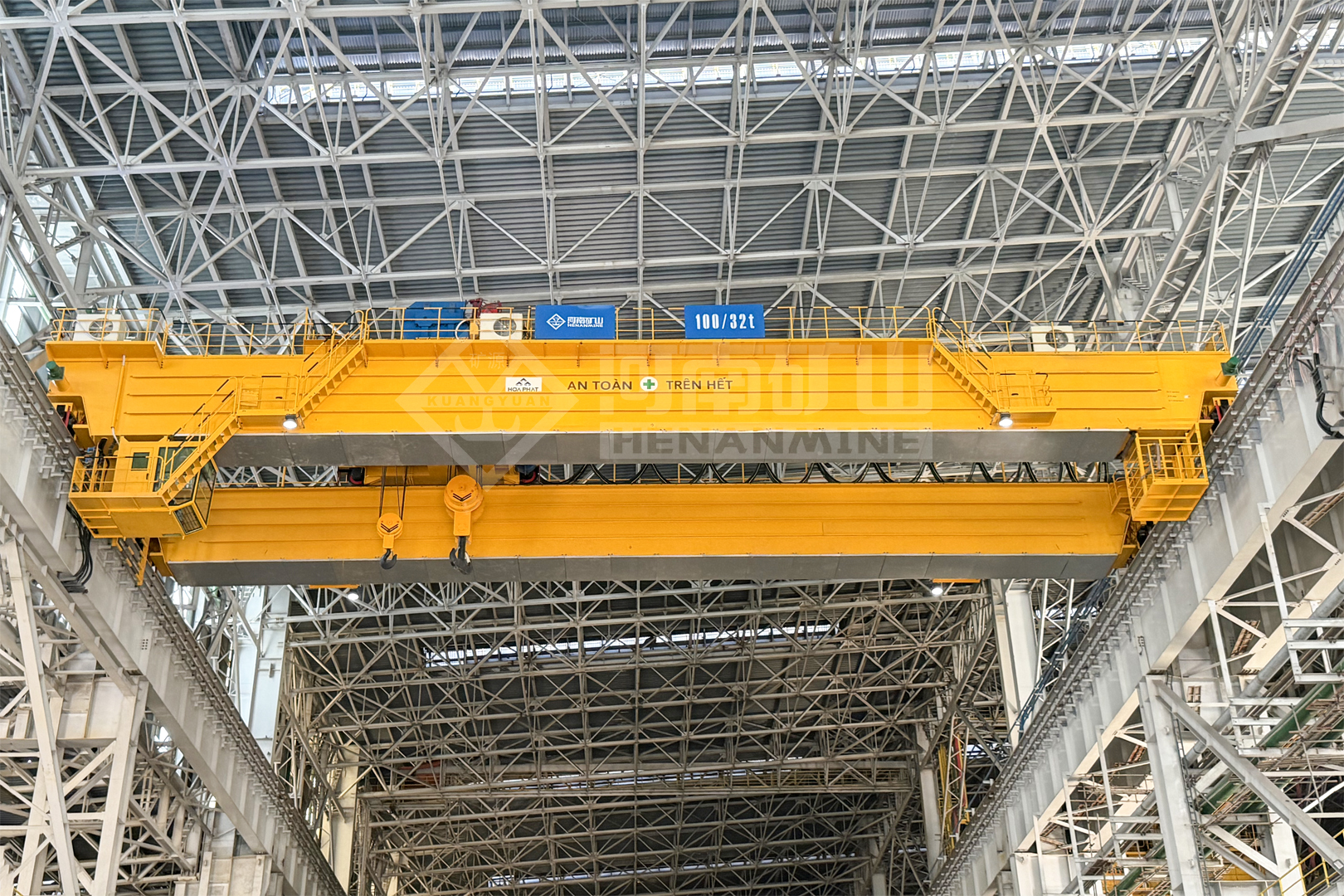
| Rated capacity | 500 t |
| Customer | Guoshi Heavy Industry |
| Location | Qiqihar |
| Application | Large energy-component manufacturing |
| Hook functions | Coordinated main, auxiliary and additional hooks |
Structure for large-component handling
The main structure uses high-strength steel, with finite-element analysis supporting the structural design. The arrangement addresses the loads and geometry established for the project.
Guoshi Heavy Industry, founded in 2010, manufactures components for nuclear energy, hydrogenation, other energy applications and offshore wind. The crane supports heavy lifting within this manufacturing environment.
Coordinate main, auxiliary and additional hooks
Variable-frequency drives, PLC control and information transmission support interaction between the main, auxiliary and additional hooks. The operator interface connects those mechanisms within the required handling sequence.
Anti-sway control monitors suspended-load movement and adjusts the operating trajectory. Protective functions are included within the equipment’s control arrangement.
Specify how the component will be lifted
A heavy-component enquiry should include the maximum weight, lifting points, centre of gravity and the required rotation or positioning sequence. Identify which hooks are used at each stage and how the load is shared during coordinated operation.
Include the building layout, available headroom, runway information and manufacturing cycle. These inputs define the handling arrangement beyond the crane’s rated capacity.
Agree the project acceptance programme
The technical order should identify the required documents, factory demonstrations and site-commissioning tasks. The receiving manufacturing team can then assess the crane against the agreed component-handling sequence.