
Container Straddle Carrier
Lift, carry and place containers between terminal blocks and truck or rail interfaces without a continuous fixed runway.
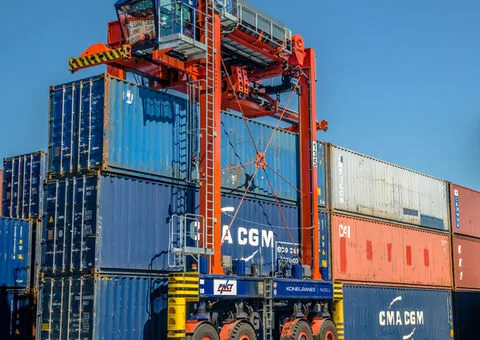
Choose the carrier around the tightest loaded route.
A straddle carrier travels with a suspended container, so the narrowest lane, tightest turn, pavement, crossing and stopping distance can control its design. Match stacking and truck/rail interfaces to that same route.
State stack tiers, rehandling pattern, row clearance and travel distances.
Check trailer deck height, traffic separation and positioning space.
Map trackside clearance, crossings and loaded maneuvering.
Specifications for the Container Carrier selection.
Container-carrier capacity and geometry depend on the selected model and terminal route. Ask for one rated configuration with matching lift, clear width, steering and tire reactions.
| Parameter | Reference selection range | Procurement check |
|---|---|---|
| Container formats | 20 / 40 / 45 ft by spreader choice | Confirm actual box mix, reefer clearance and lifting interface. |
| Rated capacity | Selected from heaviest loaded container + tool | Show rating basis and spreader self-weight for the ordered machine. |
| Stacking height / tiers | Set from yard plan | Check required under-spreader height and overall machine height. |
| Clear inside width | Set from container, trailer and lane | Check skewed approaches and the tightest operational clearance. |
| Steering / turning | Matched to route geometry | Verify all loaded corners, reversals and intersections. |
| Travel speed / braking | Matched to loaded route and duty | State test conditions and stopping distance, not top speed alone. |
| Tire and axle load | Calculated for final machine | Check slab, pavement, crossings, slopes and drainage. |
| Power and operator mode | Diesel, hybrid or electric by offer | Compare charging/fueling infrastructure and shift coverage. |
| Duty / moves per hour | From complete pickup-to-set-down cycle | Include loaded travel, turns, positioning and empty return. |
Survey the complete route with a loaded box.
The lifting calculation and route geometry must be solved together. A carrier that can pick up the container still needs enough clearance, stability, braking and pavement support during travel.
Load and spreaderGive maximum gross container, formats, spreader and lifting mode.
Stack and transferProvide tiers, pickup height, trailer position and rail interface.
Loaded routeMark lane widths, turns, crossings, grades and travel distance.
Ground and cycleProvide pavement capacity, shifts, moves per hour and power concept.
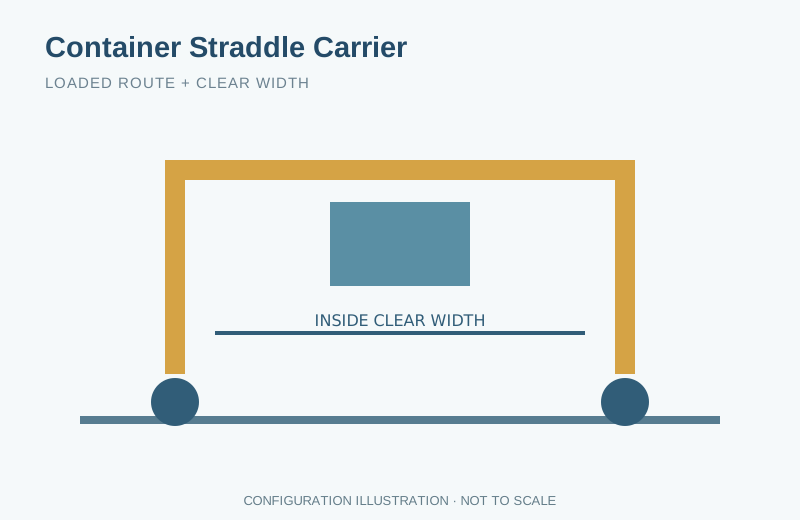
Check loaded turning, braking and tire reactions against the terminal route.
Buy lifting and transport as one system.
Specify the machine and spreader alongside the loaded route, power concept and site acceptance. A static lift test alone does not prove terminal fitness.
Request overall dimensions, clear width, lifting height, turning geometry and tire reactions.
List power train, steering, brakes, spreader, visibility and automation interfaces.
Test pickup, travel, turns, braking, parking and accurate set-down on the approved route.
Before you release a purchase order.
Use these questions to compare suppliers against the same technical and delivery scope.
How is carrier capacity selected?
Use the heaviest gross container plus spreader and other suspended equipment. Verify the rated condition for travel as well as lifting.
How is this different from an RTG?
A carrier takes the container along a loaded yard route. An RTG straddles a wider storage block and truck lane for stacking while moving on tires.
What is the minimum order?
Request a quotation for one complete carrier with its spreader. Confirm the commercial minimum, power package and site services.
What should delivery and acceptance include?
Agree a dated factory dispatch milestone, site commissioning and loaded pickup, travel, steering, braking and set-down tests.
Send the yard route and container mix.
Share container formats and gross mass, stacking tiers, truck and rail transfer positions, tightest lanes and turns, pavement data, target moves per hour, power and destination. Request a matched GA, tire loads and loaded-route test plan.
Send your Container Carrier crane enquiry ↗- Container sizes and maximum gross mass
- Spreader mode and stack tiers
- Pickup and transfer heights
- Route widths, turns and slopes
- Pavement capacity and move rate
- Power, controls and destination