Compare port crane and container-handling equipment types
Choose by the job the equipment needs to do, then compare capacity, working geometry and mobility. Open each specification panel for the available configuration data.
Set from maximum container gross mass and the lifting-attachment basis
Container interface
Spreader matched to the actual container-size mix
Clear inside width
Set from container, trailer and route clearance
Lift / under-clearance
Set from pickup, loaded travel and placement geometry
Stacking duty
Transfer-only and high-stack arrangements are specified separately
Steering / turning
Checked against every loaded corner and intersection
Travel / braking
Defined for the loaded route, gradients and stopping conditions
Tire / axle loads
Checked against the yard pavement and crossings
Power choice
Diesel or electric packages; operating shift and infrastructure defined by order
Operator mode
Cabin or specified remote operation
Numerical example below
MST3531EV is a 35 t electric transfer version; its dimensions are not a high-stack-carrier specification
35 t electric transfer version — MST3531EV
Scroll across to compare the complete configuration.
Parameter
Reference configuration
Rated capacity
35 t
Overall L × W × H
7,110 × 5,100 × 6,100 mm
Effective inner width
3,100 mm
Lift below spreader
6,150 mm
Wheelbase
6,010 mm
Empty / loaded travel
115 / 80 m/min
Turning radius
6,950 mm
Empty / loaded gradeability
6% / 3%
Ground clearance
230 mm
Motor power
85 kW
Battery
Lithium iron phosphate
Container formats and stacking duty are specified for the ordered carrier. These values apply only to this electric transfer version; the card photo illustrates the equipment family.
Capacity, reach, span, lifting height and operating speed must be selected together. Family options and numerical examples are not a guarantee that every combination is available.
Port crane prices
How much do port cranes and container-handling equipment cost?
Budget by equipment type and configuration. Vessel reach, rated load, stacking height, power, spreader and automation can change the equipment cost substantially.
Indicative equipment budgets · USD
Equipment / configuration
Budget reference
Scope boundary
Large Post-Panamax / Super-Post-Panamax STS
USD 8–15 million / crane
Large new quay-crane market reference; not a budget for every smaller STS arrangement
MQ40 t / 35 m portal-crane reference configuration
USD 300,000–445,000 / unit
Indicative ex-factory equipment budget; transport, installation and rail foundations excluded
Conventional 35–50 t RMG
USD 250,000–1.2 million / crane
Market planning range; geometry and controls change the scope
Conventional 30–50 t RTG
USD 100,000–500,000 / crane
Market planning range; power system and stacking requirements matter
30–50 t container straddle carrier
USD 120,000–450,000 / unit
Market planning range; transfer and stacking carriers have different specifications
Indicative equipment budgets for the configurations shown. High-automation systems and larger capacities can fall outside these ranges. Request a dated quotation with the selected equipment and delivery scope.
Ask for separate line items for the crane and lifting attachment, freight, duties, rails or pavement works, electrical supply, assembly, commissioning and training. No common delivery term or installation allowance is assumed in the ranges above.
See how rail-mounted container cranes have been applied to fixed-rail yards. Each project below concerns RMG equipment.
RMG container-yard project
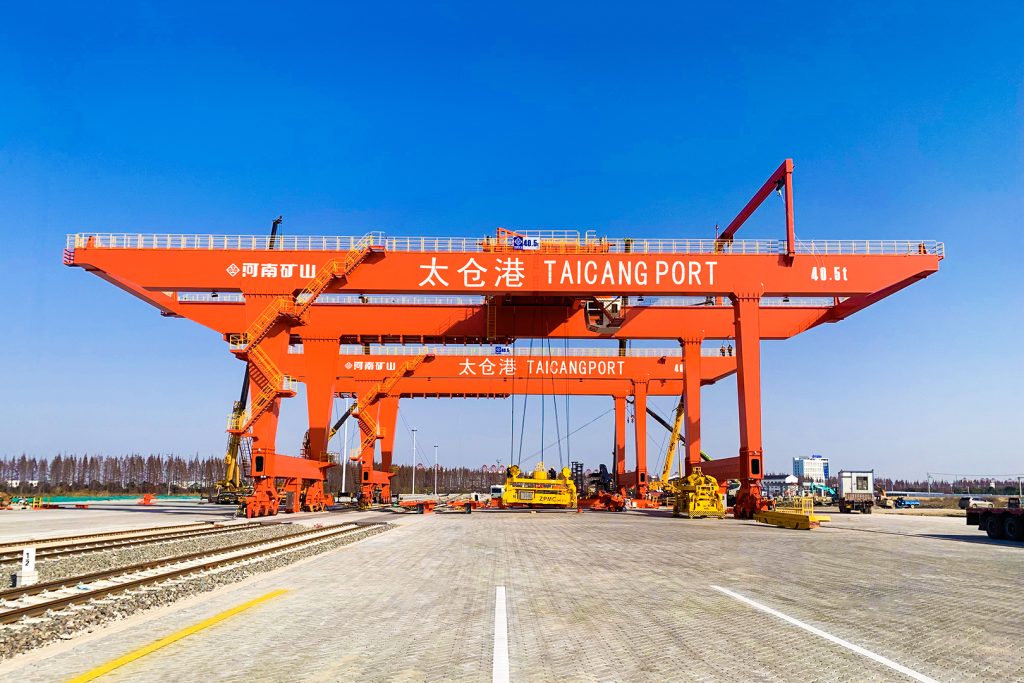
Two 40.5 t RMG Cranes for Taicang Port
Henan Mine Crane delivered two 40.5 t rail-mounted container gantry cranes for Taicang Port. Variable-frequency drives, PLC control, anti-sway and remote monitoring support container-yard handling.
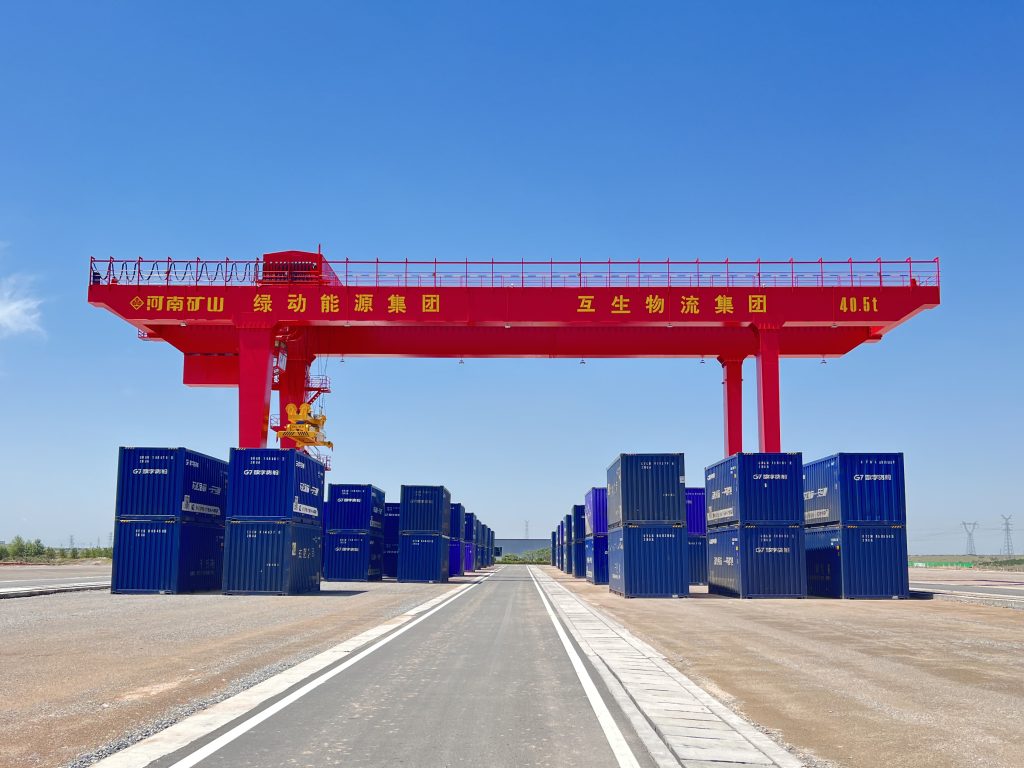
Container Handling at Wanli New Energy Smart Dry Port
A rail-mounted container gantry crane serves Wanli New Energy Smart Dry Port in Ordos. Its handling package includes variable-frequency drives, Siemens PLC control, remote monitoring and anti-sway functions.
Wanli New Energy Smart Dry Port · RMG container handling
Port crane buying questions
Which port crane should I choose?
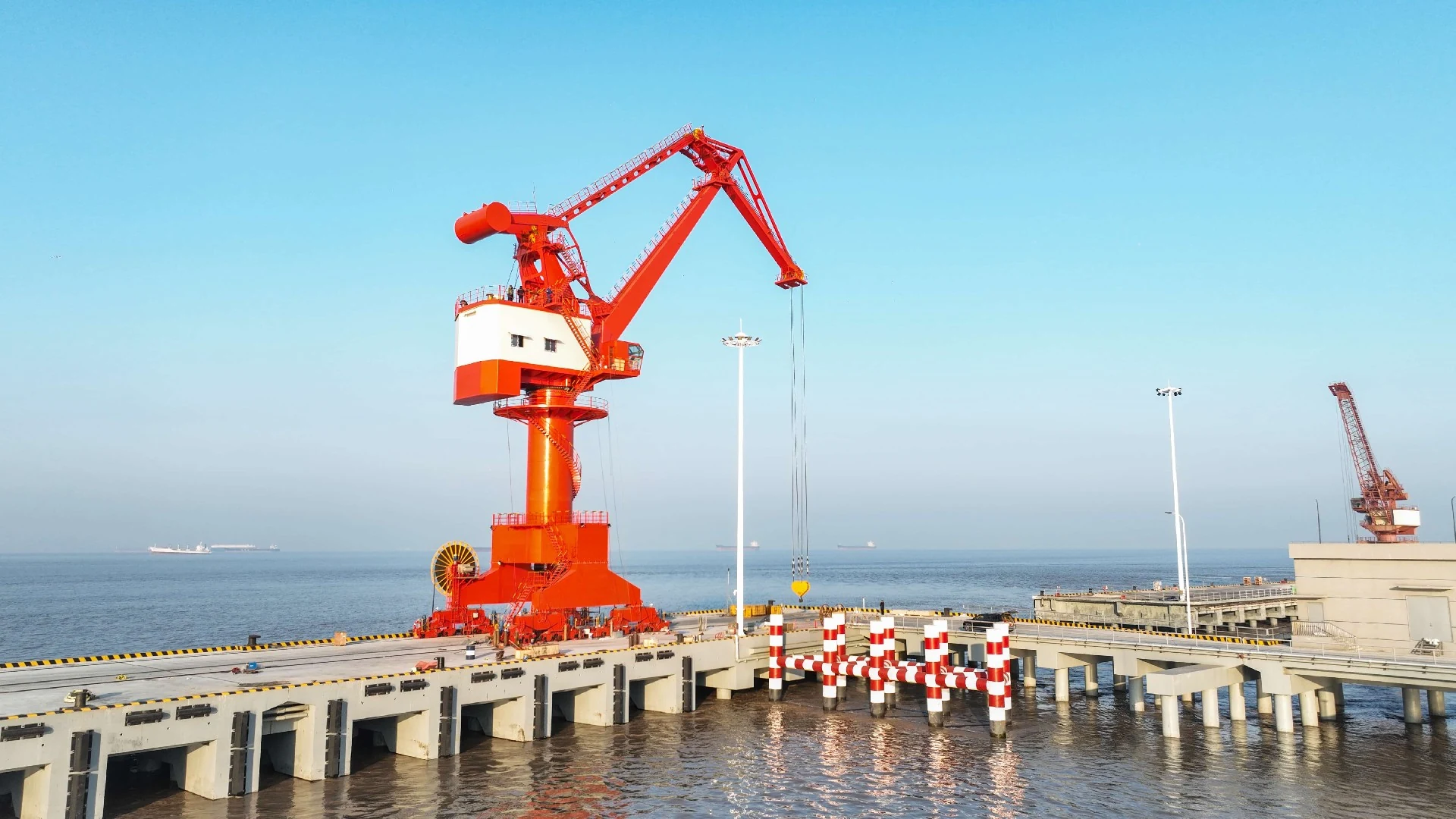
Choose STS for vessel-to-quay container handling, a portal harbor crane for mixed or bulk cargo, RMG for a fixed rail block, RTG for a mobile container block, and a straddle carrier when the machine must travel with the container.
What is the difference between an RMG and an RTG?
An RMG runs on fixed rails; an RTG uses rubber-tired travel. Compare the yard block, rail or pavement capacity, stacking plan, electrical infrastructure and block-transfer requirement before choosing.
Why does a portal crane need a load chart?
The safe rating depends on working radius and attachment duty. Compare hook and grab ratings at the actual ship and shore positions; the maximum tonnage alone does not define the usable lifting envelope.
Does the capacity include the spreader or grab?
State the required payload under the spreader or hook. The design must also account for the lifting attachment, rigging and other suspended equipment; the quotation should identify this rating basis clearly.
What do I need for an initial quotation?
Start with the cargo or container type, maximum load, lifting task and destination. Add the required reach, span or lifting height if known. A berth or yard sketch helps; detailed site information can follow during selection.
Can I buy one crane, and what is included?
Enquire for one complete crane or a coordinated terminal package. Confirm order quantity, spreader or grab, power and controls, transport, site assembly, commissioning and training in the written quotation.
What documents and tests should be included?
Specify the destination requirements, arrangement drawing, rated-load schedule, civil reactions, electrical drawings, manuals, inspection records and agreed factory and site tests. Certification applies to the ordered machine and destination.
How are delivery, installation and warranty agreed?
Confirm engineering approval, manufacture, inspection, dispatch and site milestones. Identify installation supervision, operator training, warranty coverage and start date, spare parts and technical-support scope in the contract.
Compare the range
Port crane and container-handling equipment comparison
Compare the handling task, capacity basis and travel arrangement. Select a full product name to open its details.
STS data refers to the four reference arrangements in its card. RMG and RTG values are family options; portal ratings depend on radius. The 35 t electric carrier example is a transfer configuration, not a universal stacking specification.
Request a port crane quotation
Send the cargo or container type, maximum load, destination and handling task. Add a vessel, berth or yard sketch if available. We can then compare suitable equipment and define a clear supply scope.
Tell us whether you need one crane or a terminal package, and include your target delivery date. Installation, commissioning, documents, training and spare-parts scope can be itemized in the offer.