
What does one lift actually weigh?
Include the workpiece, slings, spreader and any lifting tool. Describe the number of lifts per shift and how often you lift near the rated load.
Put the hook where the work happens. Compare floor-mounted, wall-mounted and wall-travelling jib cranes by the load you handle, the area the hook must reach and the structure that will carry the crane.
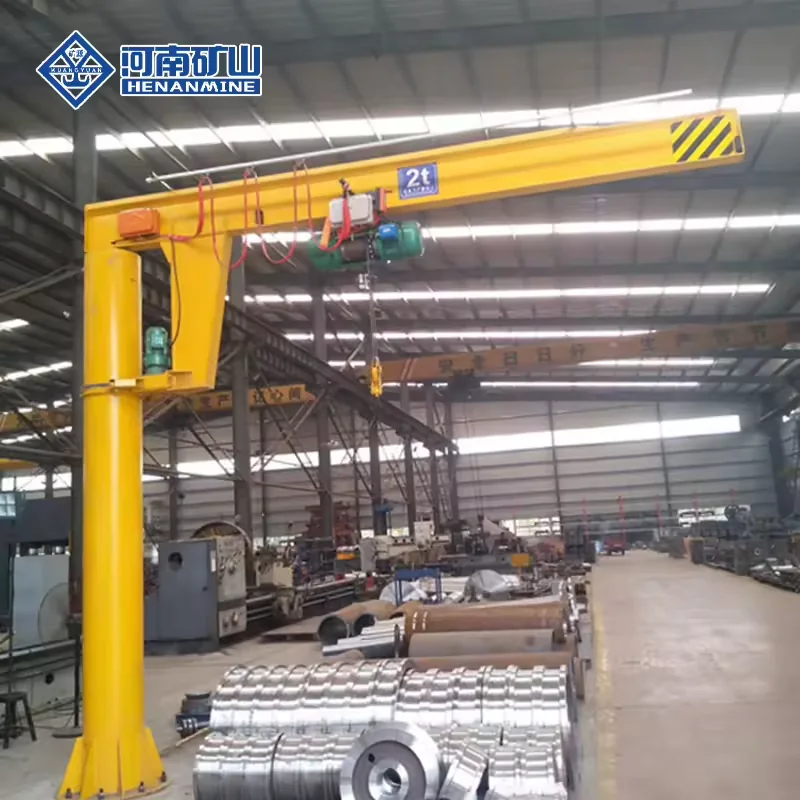
A jib crane serves a defined circular or arc-shaped working area. The selected arm length, slew range, hook approach and usable lifting height determine whether a load can move between pickup and set-down points without striking a machine, column or doorway.
Start with the complete suspended load, including rigging and attachments. Then select a supporting route: a floor-mounted pillar and foundation, a structurally suitable wall or column, or a wall-running rail system for several stations along a bay.
Include the workpiece, slings, spreader and any lifting tool. Describe the number of lifts per shift and how often you lift near the rated load.
Mark pickup and set-down points, radial reach, lowest and highest hook positions, obstructions and any restricted slew zone.
Provide slab or foundation information for a pillar crane, structural drawings for wall mounting, or rail and support details for a travelling jib.
These configurations solve different site constraints. Compare their support and coverage before selecting a hoist or asking for a price.
A dedicated lifting radius where the floor and foundation can carry the crane.
Explore pillar cranes ↓ 02 / CLEAR THE FLOORUse a suitable wall or column where a floor-mounted pillar would obstruct traffic.
Explore wall mounting ↓ 03 / MULTIPLE STATIONSExtend hook access along a bay on an engineered wall-supported travel route.
Explore wall travel ↓ 04 / CUSTOM WORK AREAShare a bay drawing so the crane arrangement can be checked against the real lift path.
Send a station brief ↓Choose a support route first. Then match the arm, hoist, controls and working duty to the same site drawing. Rated load, reach and lifting height must be confirmed together for each final configuration.
A pillar jib can serve a machine, assembly cell or loading point. Verify slab or foundation capacity, anchor pattern and allowable slew before choosing the arm and hoist.
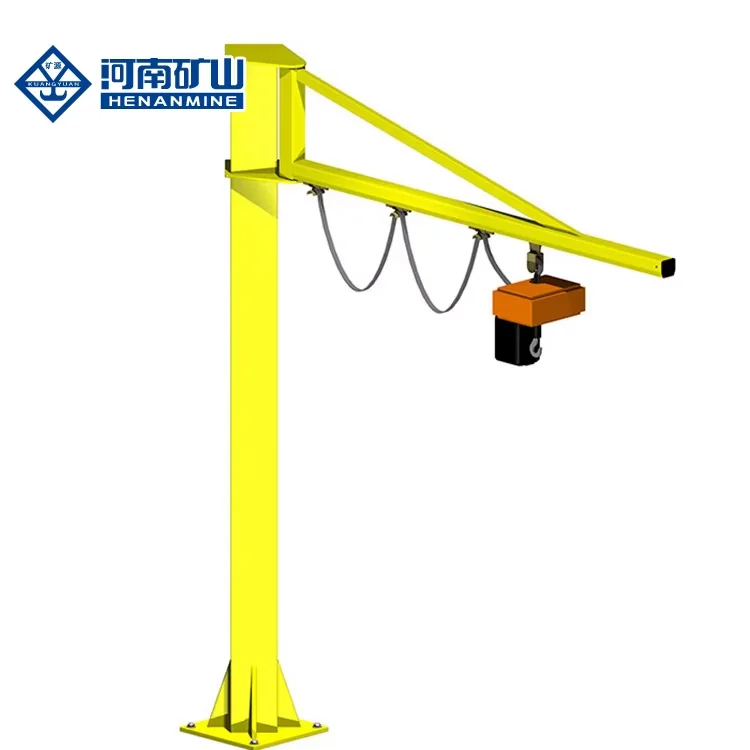 BZ / pillar jib / illustrated arrangement
For a defined workstation where a dedicated floor support is practical. Check the full suspended load and foundation reactions before finalizing arm reach, lifting height and slew limits.
| Support | Floor-mounted pillar and engineered anchorage | Rated load | Select from the complete suspended load |
|---|---|---|---|
| Working radius | Set by pickup and set-down positions | Hook height | Check upper hook position and floor clearance |
| Lifting unit | Specify hoist for load and lifting duty | Slewing | Confirm angle, drive and exclusion zones |
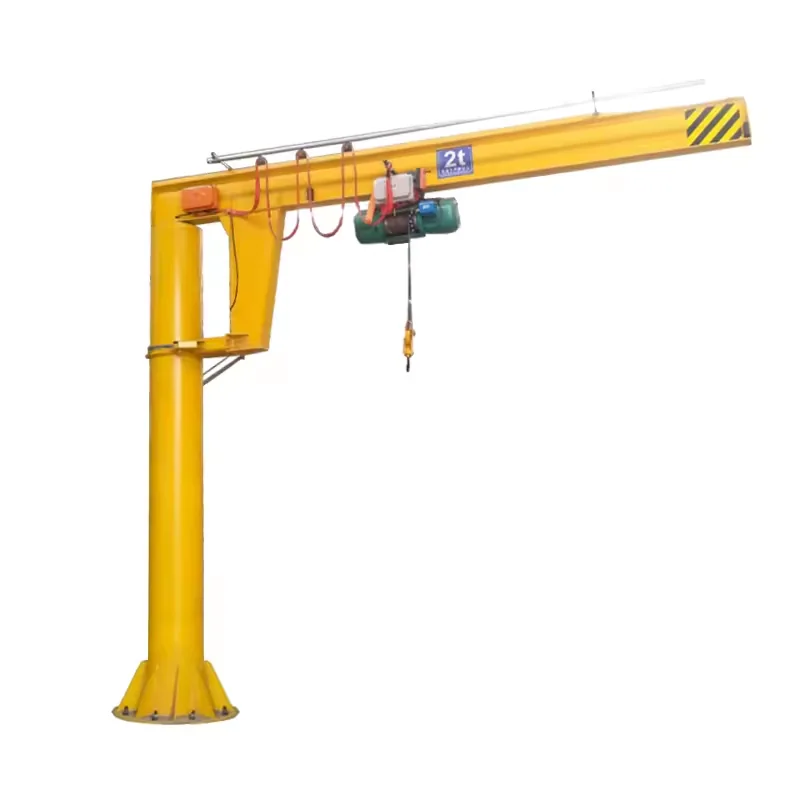 BZD / pillar jib / illustrated arrangement
Compare the arm layout and operating method against the same lifting station brief. Manual or powered slewing, control method and hoist package should be stated in the selected configuration.
| Support | Floor-mounted pillar and engineered anchorage | Rated load | Confirm for chosen hoist and arm |
|---|---|---|---|
| Working radius | Check hook approach at both arm ends | Hook height | Verify against roof and equipment |
| Lifting unit | Specify with duty and power supply | Slewing | State manual or powered operation in offer |
Wall mounting is useful beside production lines and workbenches where a suitable structural wall or column exists. The support must be checked for the crane's vertical and horizontal reactions.
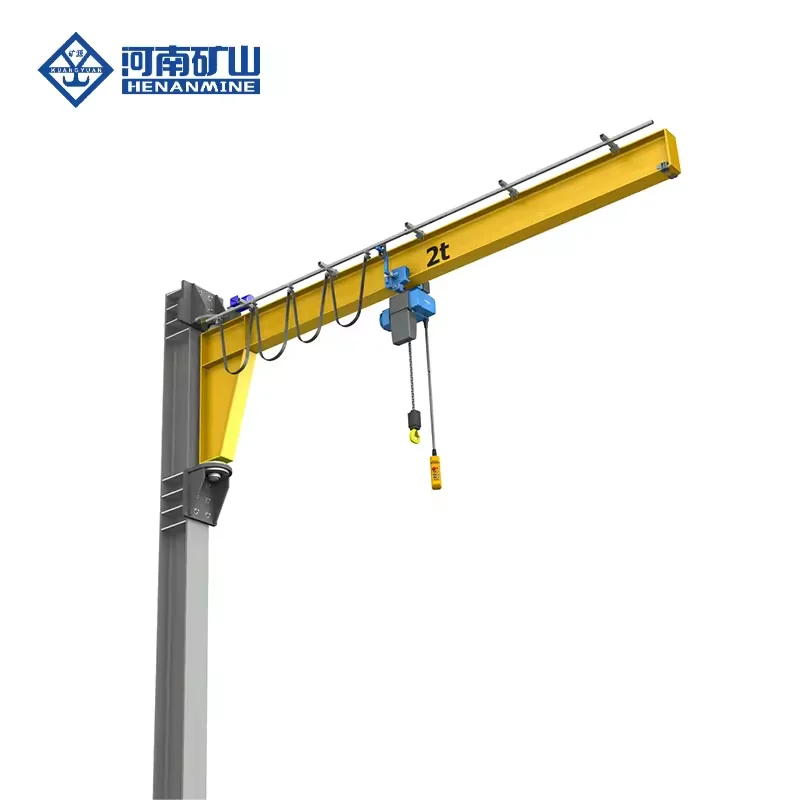 BX / wall-mounted jib / illustrated arrangement
Serve a workstation without a floor pillar. Confirm wall or column capacity, mounting elevation, arm sweep and hook approach together with the selected load and hoist.
| Support | Engineered wall or column connection | Rated load | Set from load, reach and structure |
|---|---|---|---|
| Working radius | Check along the actual work area | Hook height | Coordinate with mounting elevation |
| Lifting unit | Select for operating cycle | Slewing | Check usable angle and obstructions |
A travelling jib runs along an engineered wall-supported rail system. It answers a different question from a fixed BX wall jib: how far must the hook move along the bay as well as out from the wall?
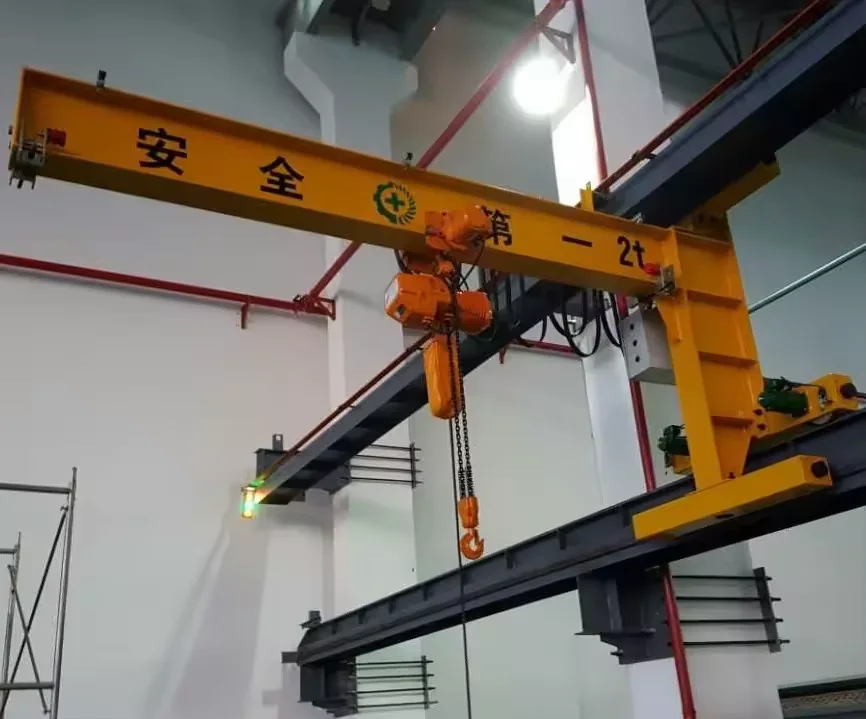 Wall-travelling / rail-supported layout
Compare this arrangement when a fixed pivot cannot cover all pickup points. The building, rail, end stops and travel path require a coordinated structural and mechanical design.
| Support | Wall-supported running rails | Rated load | Confirm with structure and duty |
|---|---|---|---|
| Reach | From wall rail to working points | Travel | Between required pickup zones |
| Lifting unit | Select for load and operating cycle | Protection | Define limits, end stops and clearances |
These paired ZB-A options help you shortlist a floor-mounted crane. The BZ and BZD arrangements above require their own configuration drawings and must not inherit these dimensions.
| ZB-A rated load | Outer hook radius | Available pairing |
|---|---|---|
| 0.25 t | 5.0 m | One listed reach |
| 0.5 t | 5.0 m | One listed reach |
| 1 t | 5.0 m | One listed reach |
| 2 t | 3.3 / 5.0 / 6.0 m | Three reach options |
| 3 t | 5.0 m | Confirm vertical dimensions on drawing |
| 5 t | 4.0 m | One listed reach |
A listed capacity or arm length alone does not define a safe combination. Request the selected crane's dimensioned arrangement and support loads.
| Layout | Where it is supported | Coverage | Key check | Next step |
|---|---|---|---|---|
| BZ pillar jib | Floor foundation | One station around a pillar | Foundation and hook sweep | Pillar detail ↗ |
| BZD pillar jib | Floor foundation | One station around a pillar | Slew method and controls | Pillar detail ↗ |
| BX wall-mounted jib | Wall or column | One wall-side station | Mounting reactions and elevation | Wall detail ↗ |
| Wall-travelling layout | Wall-supported running rails | Several stations along a bay | Rail and building load path | Wall travel detail ↗ |
Send the work area, support drawings and operating cycle so the final configuration can be checked as one system.
Discuss your lifting station ↗Choose a pillar layout when a dedicated floor foundation can support the lift station. A wall-mounted layout keeps the floor clear but needs a suitable wall or column. Compare both on the same load, hook reach, mounting height and support drawings.
Consider it when the hook must serve several stations along one bay and a fixed-pivot jib cannot cover the route. The wall, rail, travel length, end stops and structural reactions need project-specific engineering.
Provide the heaviest load including rigging, distance from pivot to pickup and set-down points, lift frequency, required hook height and the support structure. Capacity, reach and support loads should be checked as one combination.
A movable base is a separate engineering choice. The ballast or anchoring, floor loads, stability during lifting and movement route need to be checked. Do not assume a fixed floor-mounted jib can be moved while carrying a load.
Specify the destination market and required standards in the RFQ. Ask the written offer to name the applicable documents, inspection and load-test records, operating instructions and electrical information for the selected crane.
State the number of complete cranes required. The supplier's written offer should confirm minimum order, manufacturing and shipping schedule, warranty scope, installation responsibilities and spare-parts support for the chosen configuration.
Send your station sketch, suspended load, required reach, hook positions, lift frequency, support details, power supply and destination. We can compare floor, wall and wall-travelling layouts against the same brief.
Request a technical quotation