
Wall-Mounted Jib Cranes
Give one workstation its own lifting coverage without a freestanding column on the floor. The arm and hoist attach to a verified wall or building column, then rotate the load between defined pick-up and set-down points.
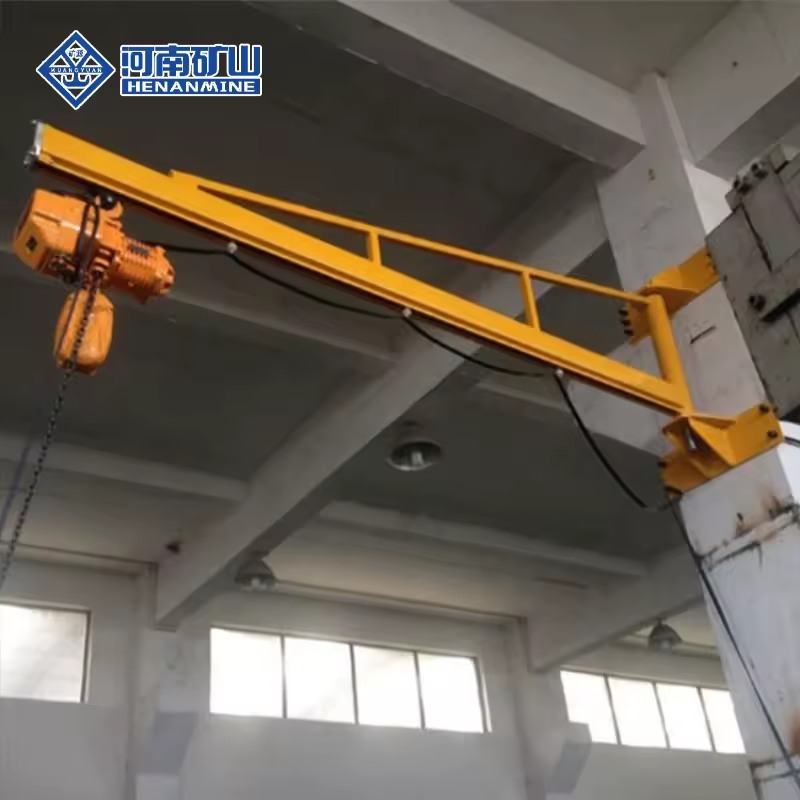
Local lifting when floor space matters.
Wall mounting works when a structural wall or column is already positioned beside the lifting task and can carry the crane reactions. It is a workstation solution, not a substitute for a crane serving the full workshop bay.
Lift components from a nearby staging point and position them at one machine without blocking the floor with a pillar base.
Move subassemblies across a defined arc; select the trolley approach and hoist lift for the highest assembly position.
Remove motors, pumps and replaceable parts where the equipment remains in place and a mobile crane route is difficult.
Start with a BX configuration, then fit it to your site.
The 0.25 t BX example below is a planning reference. A different load, radius or lifting height requires its own structural and hoist selection. The final offer identifies the selected arm, hoist, support reactions and drawing.
| Parameter | BX reference configuration | Confirm for your project |
|---|---|---|
| Arrangement | Wall-mounted jib | Existing structural wall or building column; no freestanding base. |
| Rated load | 0.25 t | Include the complete suspended load, rigging and attachment. |
| Valid radius | 4 m | Measure the farthest hook position needed, then check inner approach. |
| Lifting height | 5 m | Check lowest pick-up and highest hook positions after mounting height is set. |
| Slewing | Electric rotation | Set the permitted arc and end stops from the building plan. |
| Control | Pendant or radio remote | Choose around operator sightlines and safe standing positions. |
| Power supply | To suit the site | Provide voltage, frequency, phases and cable route. |
| Support reactions | Calculated for the final layout | Require fixing forces and moment loads before building approval. |
Check the hook envelope and building support together.
A nominal arm length is not the same as usable hook reach. The trolley stops before the arm ends; the hoist body and load dimensions reduce the working envelope further. The mounting elevation also determines how high the hook can lift.
Support locationShow the wall or column section, steel grade or concrete condition, available fixing area and any restrictions on drilling.
Working arcMark the load pick-up and set-down points, the farthest hook radius, the nearest approach, doors and obstacles.
Vertical clearanceGive floor-to-mounting height, highest load position, hoist headroom and the required hook lift.
Operating cycleState loaded lifts per hour, shifts, control preference and indoor or outdoor conditions.
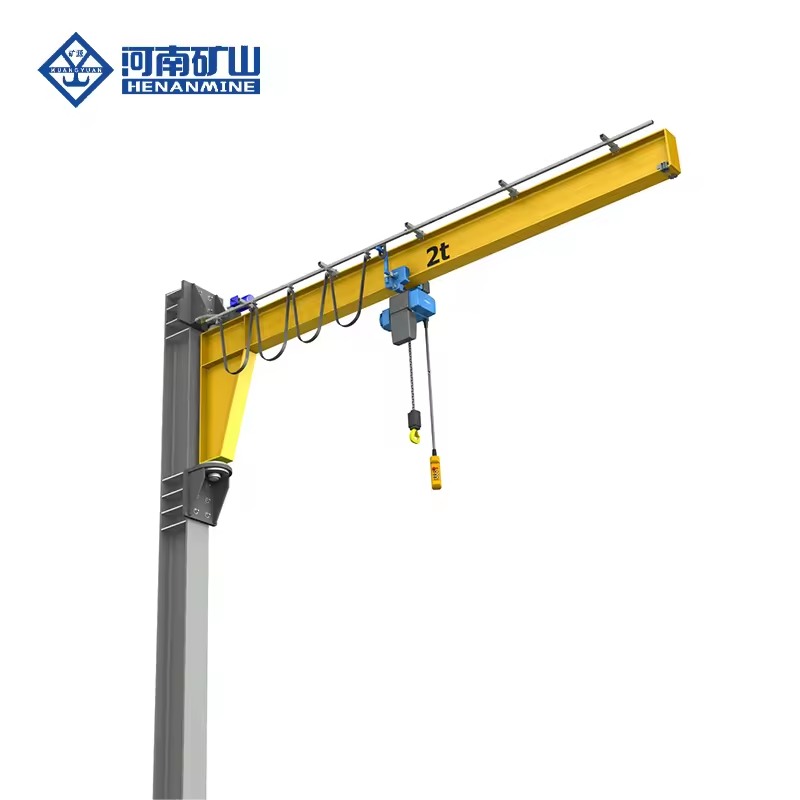
One station. Clear load movements.
Machine loading
Position workpieces between a pallet or bench and the machine within the arm's verified hook radius.
Assembly and fabrication
Turn and place components at a fixed assembly area while keeping access open for operators and material carts.
Equipment maintenance
Lift removable parts in a service zone after checking the load, rigging, hook clearance and safe set-down space.
Need coverage across the whole bay? Compare a single-girder overhead crane rather than extending a local jib beyond its working radius.
Put the equipment and installation boundary in writing.
A wall-mounted jib purchase depends on the building interface. The quotation should define the jib and hoist, the support assumptions, required documents and who performs the site work.
State rated load at working radius, hoist type, trolley and slewing drive, controls, brakes, limits and overload protection.
Request bracket and anchor details plus vertical, horizontal and overturning reactions for the final arrangement. Obtain building engineer approval.
Separate fabrication, freight, fixings, access equipment, installation, commissioning, load testing, training and spares.
Resolve these before placing the order.
These decisions affect the usable crane, installation cost and delivery scope.
Can any workshop wall support a jib crane?
No. The fixing point must be checked for vertical load, horizontal load and overturning moment from the selected crane and lifted load. Send structural drawings for the building engineer's review before ordering.
Does a 4 m arm give 4 m of hook coverage?
Not automatically. The usable outer and inner hook radii depend on the trolley stops, hoist dimensions, arm geometry and obstructions. Ask for a plan showing the actual hook path.
Is the 0.25 t BX example the only available capacity?
It is one configuration, not a limit for every wall-mounted jib. Specify your complete load and working radius so a suitable structure and hoist can be selected and confirmed in the technical offer.
What certification, delivery and warranty should I expect?
State the destination and required documents with your enquiry. The quotation should identify the actual certificates and inspection records, manufacturing schedule after approved drawings, shipment scope and the written warranty terms.
Show us the wall and the lifting path.
Send the load with rigging, required hook radius and height, wall or column drawing, work cycle, power supply and destination. We can then define the jib configuration, support reactions, documentation and schedule in one comparable offer.
Send your jib crane enquiry ↗- Maximum complete suspended load
- Outer and inner hook positions
- Mounting height and available support
- Allowed slewing arc and obstacles
- Lifts per hour and daily shifts
- Power supply, destination and site-work scope