
Pillar Jib Cranes for Defined Work Areas
Give one workstation its own lifting radius without building a full-bay runway. Start with the load, actual hook reach and lift height, then match the jib, hoist and foundation to the site.
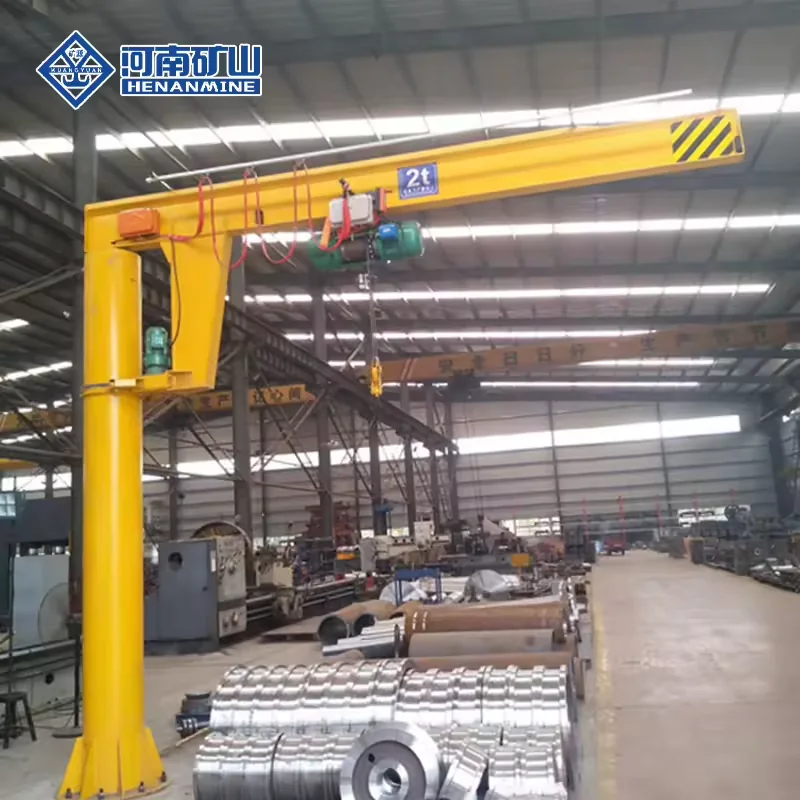
Put the hook where a full-bay crane cannot work efficiently.
A pillar jib serves repeated lifts within a local arc. Its value depends on reaching the pickup and set-down points, not simply on having a long boom.
Handle tooling, dies and components near machines without diverting a bridge crane from other work.
Place motors and fabricated assemblies at defined heights while leaving a clear operator route.
Move packaged equipment between a staging area and a fixed workstation within the permitted slewing sector.
Match the ZB-A configuration to the actual lift.
The rows below are paired configurations. Select a complete row for preliminary comparison; the final drawing must confirm the hoist, lift, reach and support reactions together.
| ZB-A type | Load (t) | Hoist speed (m/min) | Slewing (r/min) | L (mm) | R₂ (mm) | R₁ (mm) | H (mm) | h (mm) |
|---|---|---|---|---|---|---|---|---|
| ZB-A0.25-D/S | 0.25 | 4 / 1; 8 / 2 | 0.92 | 5,425 | 5,000 | 1,000 | 5,100 | 4,000 |
| ZB-A0.5-D/S | 0.5 | 4 / 1; 8; 8 / 0.8 | 0.92 | 5,425 | 5,000 | 1,000 | 5,100 | 4,000 |
| ZB-A1-D/S | 1 | 8 / 2; 8; 8 / 0.8 | 0.76 | 5,500 | 5,000 | 1,000 | 5,100 | 4,000 |
| ZB-A2-D/S · short reach | 2 | 4 / 1; 8; 8 / 0.8 | 0.76 | 3,765 | 3,300 | 1,300 | 4,350 | 3,000 |
| ZB-A2-D/S · medium reach | 2 | 4 / 1; 8; 8 / 0.8 | 0.59 | 5,565 | 5,000 | 1,300 | 5,400 | 4,000 |
| ZB-A2-D/S · long reach | 2 | 4 / 1; 8; 8 / 0.8 | 0.51 | 6,525 | 6,000 | 1,500 | 4,660 | 3,500 |
| ZB-A3-D/S | 3 | 8; 8 / 0.8 | 0.51 | 5,560 | 5,000 | 1,500 | See drawing* | See drawing* |
| ZB-A5-D/S | 5 | 8; 8 / 0.8 | 0.51 | 4,680 | 4,000 | 1,800 | 4,770 | 3,000 |
Different jib codes need their own technical offer.
Use the ZB-A data above for ZB-A selection. BZ and BZD pillar arrangements can be discussed when the site needs a different hoist or slewing drive; their load and dimensions must be confirmed separately.
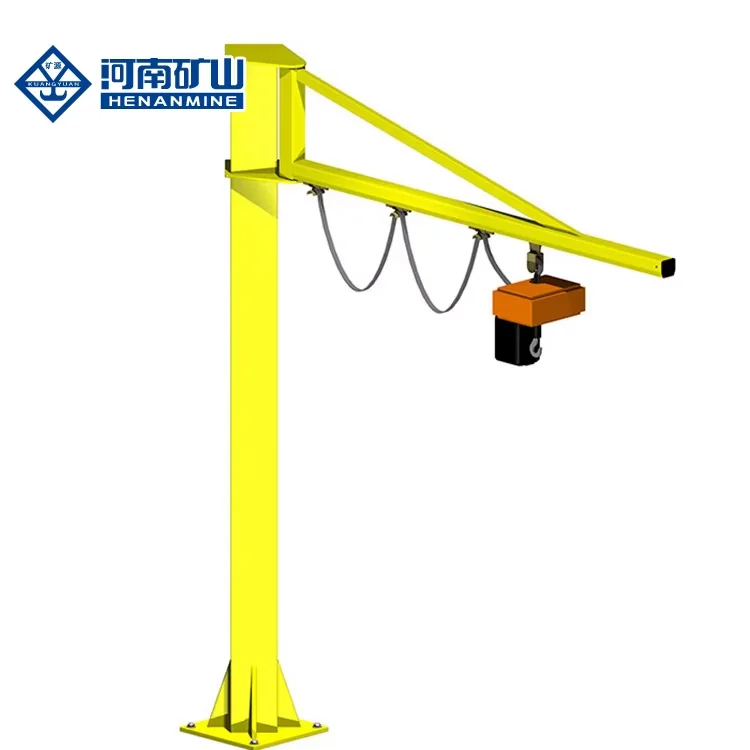
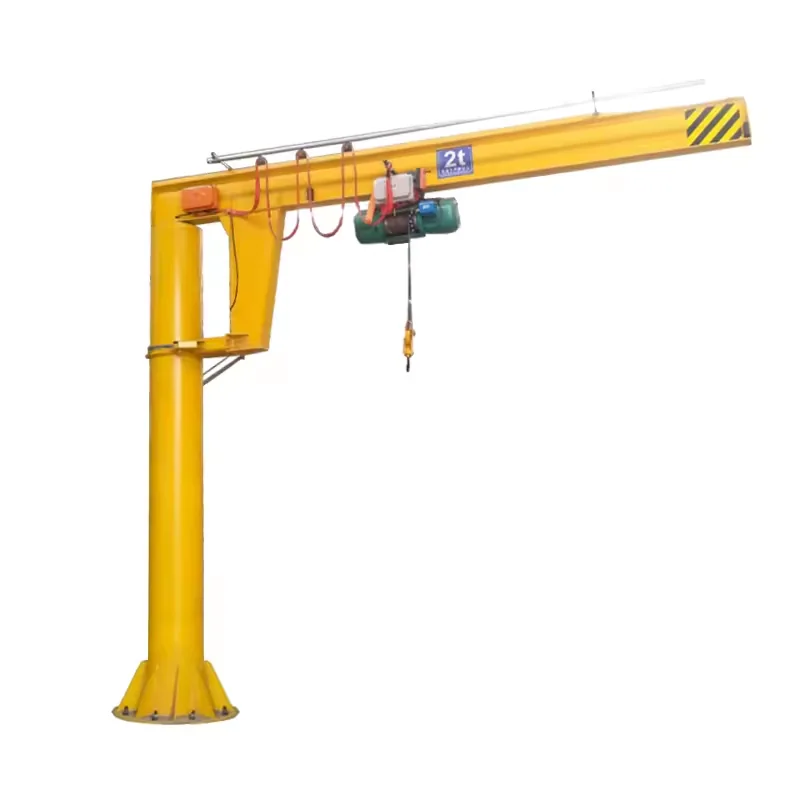
Draw the hook path before selecting the boom.
The support sees the highest moment when a loaded hook approaches the outer radius. A useful proposal needs both hook limits and the real operating sector.
Complete lifted loadAdd the payload, rigging and any permanent below-the-hook device.
Hook-centre radiiMark the nearest and farthest required positions. Do not substitute physical boom length for usable reach.
Vertical hook travelGive the lowest pickup, highest set-down point, load depth and available roof clearance.
Slewing and supportShow obstacles, required rotation sector, slab or foundation plan, anchors and nearby underground services.
The supplier should provide crane reactions and an approved foundation/anchor interface. The responsible structural engineer must verify the slab, footing and ground conditions.
Specify the whole lifting station, not only the crane arm.
A comparable quotation states the selected jib configuration, hoist, site interface, document pack and delivery boundary.
Name the chosen ZB-A capacity and reach row, hoist type and speed, trolley, slewing method, limits, brakes and overload measures.
Request the general arrangement, maximum reactions and anchor loads. Include foundation design and installation responsibilities in the contract.
Separate freight, unloading, erection, electrical hookup, test loading, operator training and the initial spare-parts list.
Resolve these questions before you place the order.
The right answer depends on your operating envelope, frequency and supporting structure.
Will the outer hook reach the pickup point?
Compare the required hook-centre radius with R₂ of the selected configuration. Check R₁ as well: the hoist cannot always travel close to the column. Provide a plan with pickup and set-down coordinates.
Can we bolt the column to our existing concrete slab?
Do not assume so. A loaded boom creates an overturning moment as well as vertical and horizontal reactions. Obtain the selected crane reactions and have the slab, footing, anchors and ground checked before installation.
Does every ZB-A size allow full 360° rotation?
The necessary slewing sector must be checked against structural details, electrical supply and surrounding obstacles. State the required angle on the layout and confirm it on the approved drawing.
Are ZB-A, BZ and BZD dimensions interchangeable?
No. Specify the requested arrangement by code and require a separate configuration drawing. Hoist type, drive and boom geometry can change the hook range and foundation loads.
Which certification, lead time and warranty apply?
Those items must be stated for the ordered configuration and destination. Request a document list, dated dispatch milestone and written warranty scope before releasing the purchase order.
Send the lift points. Get a buildable configuration.
Share the complete load, inner and outer hook positions, lift height, rotation sector, lifts per shift, floor or foundation drawing, power supply and delivery destination. Ask for a matched ZB-A row or a separately specified alternative.
Send your pillar jib enquiry ↗- Payload, rigging and lifting attachment
- Inner and outer hook-centre radii
- Highest and lowest hook positions
- Required slewing sector and obstacles
- Cycles per shift and hoist preference
- Foundation/slab information and site destination