

Jib Crane Prices
Compare capacity, reach and mounting type before budgeting your workstation crane.
USD budget ranges · 30 October 2026 · 14 configurations
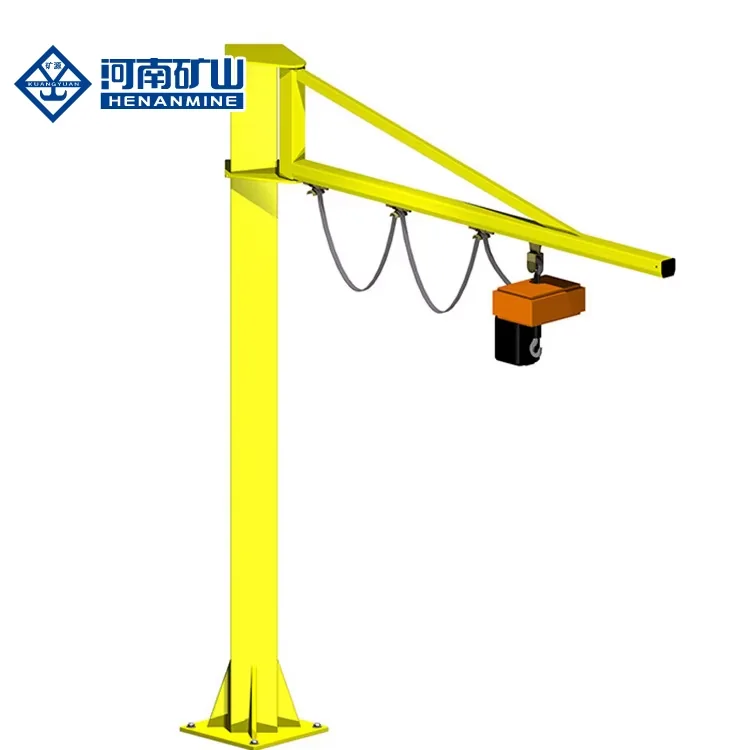
Jib crane price table by capacity and mounting type
Jib crane prices depend on capacity, working reach, mounting and powered motions. For preliminary indoor equipment planning, 0.5–2 t freestanding pillar jibs are estimated at USD $1,500–$7,500; fixed wall-mounted jibs at USD $1,200–$6,000. A 1–5 t wall-travelling crane assembly has a separate allowance of USD $6,500–$30,000, excluding its runway infrastructure.
Compare 14 planning configurations. Filter by capacity or installation type. Capacities are metric tonnes: 0.5 t = 500 kg and 1 t = 1,000 kg. Reach and maximum hook height are budgeting assumptions, not confirmed product combinations.
Preliminary planning estimates in USD, not stock prices or binding quotations. Equipment scope and geometry are defined below. Actual proposals may fall outside these ranges. Site support, foundations, runway infrastructure, packing, freight, taxes and installation are excluded.
| Capacity | Product configuration | Planning specification | Equipment budget | Typical fit |
|---|---|---|---|---|
| 0.25 trated capacity | ZB-AFreestanding pillar jib crane freestanding |
| USD $1,200–$2,500Planning estimate | Machine loading and handling around a fixed workstation |
| 0.5 trated capacity | ZB-AFreestanding pillar jib crane freestanding |
| USD $1,500–$3,500Planning estimate | Machine loading and handling around a fixed workstation |
| 1 trated capacity | ZB-AFreestanding pillar jib crane freestanding |
| USD $2,200–$5,000Planning estimate | Machine loading and handling around a fixed workstation |
| 2 trated capacity | ZB-AFreestanding pillar jib crane freestanding |
| USD $3,500–$7,500Planning estimate | Machine loading and handling around a fixed workstation |
| 3 trated capacity | ZB-AFreestanding pillar jib crane freestanding |
| USD $5,000–$10,000Planning estimate | Machine loading and handling around a fixed workstation |
| 5 trated capacity | ZB-AFreestanding pillar jib crane freestanding |
| USD $8,000–$15,000Planning estimate | Machine loading and handling around a fixed workstation |
| 0.25 trated capacity | BXWall-mounted jib crane wall |
| USD $900–$1,800Planning estimate | Wall-side handling where a verified structural support is available |
| 0.5 trated capacity | BXWall-mounted jib crane wall |
| USD $1,200–$2,500Planning estimate | Wall-side handling where a verified structural support is available |
| 1 trated capacity | BXWall-mounted jib crane wall |
| USD $1,800–$4,000Planning estimate | Wall-side handling where a verified structural support is available |
| 2 trated capacity | BXWall-mounted jib crane wall |
| USD $2,800–$6,000Planning estimate | Wall-side handling where a verified structural support is available |
| 1 trated capacity | Wall travellingWall-travelling jib crane travelling |
| USD $6,500–$13,000Planning estimate | Multiple workstations along a dedicated elevated runway |
| 2 trated capacity | Wall travellingWall-travelling jib crane travelling |
| USD $8,500–$17,000Planning estimate | Multiple workstations along a dedicated elevated runway |
| 3 trated capacity | Wall travellingWall-travelling jib crane travelling |
| USD $11,000–$22,000Planning estimate | Multiple workstations along a dedicated elevated runway |
| 5 trated capacity | Wall travellingWall-travelling jib crane travelling |
| USD $15,000–$30,000Planning estimate | Multiple workstations along a dedicated elevated runway |
No matching configuration. Choose another option or reset the filters.
What is included in these jib crane prices?
The main table gives preliminary equipment budget estimates for indoor hook lifting. Pillar and fixed wall-mounted allowances include the boom, column or mounting brackets as applicable, electric chain hoist, trolley, basic pendant controls and on-crane wiring. The 0.25–2 t pillar and all fixed wall-mounted rows assume manual slewing and a push trolley. The 3–5 t pillar rows allow for powered slewing and a powered trolley.
Wall-travelling allowances cover the cantilever crane assembly, electric hoist, powered trolley, long-travel drives, on-crane electrical equipment and basic controls. Runway beams, rails, building connections and runway power feed are separate. They do not describe a complete installed runway system.
Equipment allowance
- One crane with the stated mounting arrangement
- Electric chain hoist and selected trolley
- Manual or powered motion as identified
- Basic pendant operation and on-crane wiring
Separate project costs
- Foundation, anchor supply and civil work
- Building checks, reinforcement and runway infrastructure
- Site power, packing, freight, duties and taxes
- Installation, commissioning and acceptance testing
Reach means the assumed outer working radius to the hook for a slewing jib, or useful hook outreach from the support line for a wall-travelling design. Maximum hook height is measured above the working floor. It is different from column height, underside-of-boom height and vertical hook travel. Hoist headroom and end approaches reduce usable coverage.
The listed dimensions define budgeting scenarios, not approved capacity/radius/height combinations or a stock specification. The final drawing establishes useful coverage, rotation limits and the rating throughout the permitted operating range. Outdoor, corrosive, hazardous-area and continuous-production service need separate selection.
Floor mounted, wall mounted or wall travelling: which should you buy?
ZB-A freestanding pillar jib crane
Local lifting around machines, benches or an assembly station. Compare pillar jib cranes when the work area needs coverage around an independent column. The support does not rely on an overhead building connection, but its base still needs a designed load path into suitable concrete and ground.
Check the entire working arc against machines, doors, overhead services and pedestrian routes. A nominal 360° sweep does not guarantee unlimited continuous rotation: stops, cable routing and any rotary power connection determine what is available.
BX wall-mounted jib crane
Fixed workstation lifting without a floor-mounted column. Compare wall-mounted jib cranes where a suitable structural wall or column can carry the bracket reactions. This can reduce the crane structure required, but reinforcement or a new supporting column can outweigh the equipment saving.
Wall-bracket and cantilever arrangements also need different overhead clearances. Compare the useful hook height and full boom envelope, not just the mounting elevation. A partition wall or an unverified workshop column is not an acceptable basis for budgeting the installation.
Wall-travelling jib crane
Extended coverage along a row of machines or assembly bays. A wall-travelling jib crane moves along its own elevated runway, while the hoist traverses the cantilever. It serves a different footprint from a jib that rotates at one fixed mounting point.
Allow for vertical and horizontal support reactions, runway alignment, end stops, power supply and clearance to other cranes. Do not assume a travelling cantilever also slews; that function must appear in the agreed design.
1 ton jib crane prices: what does the configuration change?
Consider a 1 t lift, 4 m useful reach and 3 m maximum hook height in an indoor workshop. These illustrative equipment allowances compare different solutions to that task. They are planning estimates, not a completed customer case or a confirmed technical offer.
| 1 t configuration | Equipment budget | Purchase decision |
|---|---|---|
| BX wall mounted; manual slew and push trolley | USD $1,800–$4,000 | Price structural verification and the bracket connection separately. |
| ZB-A pillar; manual slew and push trolley | USD $2,200–$5,000 | Compare the work envelope and the required foundation. |
| Pillar jib; powered slew and powered trolley | USD $3,200–$6,500 | Consider repeated positioning, operator access and motion control. |
| Wall travelling; powered runway travel and trolley | USD $6,500–$13,000 | Useful for several stations; runway infrastructure is excluded. |
All four include a basic electric chain hoist. The powered-pillar row is a separate budget scenario, not an assumed upgrade percentage. Comparing only the cheapest equipment endpoint hides the costs of foundations, support steel and the different areas served.
Machine-loading example: coverage comes before a larger capacity
Suppose the part weighs 700 kg and its lifting tackle weighs 100 kg. The total suspended load is 800 kg. A 1 t class jib may be a candidate, subject to its rating and operating conditions. If pickup and placement need 4 m of useful reach, a cheaper 3 m jib does not solve the task. Increasing capacity alone does not fix a coverage shortage.
What changes the cost of a jib crane?
Working radius and support reactions
Longer reach changes the boom, bearing arrangement and support demand. As a simple illustration, a 1,000 kg payload produces about 29.4 kN·m of static moment at 3 m, versus 49.1 kN·m at 5 m. This excludes crane and hoist self-weight, dynamics and design factors; it is not a foundation or anchor calculation. It explains why identical tonnage can need a different budget.
Hook height and headroom
Maximum hook height must clear the load, lifting tackle, machine enclosure and placement level. Column height alone does not answer that question. Hoist and trolley headroom, upper limits and the boom structure affect the useful lift. A low-headroom hoist or taller column changes the equipment and installation scope.
Hoist, trolley and slewing control
Manual lifting, electric chain hoisting and wire-rope hoisting are different packages. Trolley travel and boom rotation can each be manual or powered. Price the actual motions separately. Variable-speed operation, remote control and positioning features need compatible drives and electrical equipment, rather than a generic control-box allowance.
Work cycle and environment
Load spectrum, lifts per hour, operating hours and positioning requirements guide the duty selection. A capacity label does not establish a duty class. Outdoor exposure adds wind and corrosion considerations; washdown, dust and classified hazardous areas can require a different equipment package. None is included by default in the indoor table.
Foundation and building condition
For pillar cranes, concrete strength, slab or footing geometry, reinforcement, anchors, edge distances and ground conditions all matter. For wall-mounted cranes, bracket loads must be traced through the building structure. Use the selected crane's reaction data and connection drawing for structural review. There is no universal slab thickness that approves every jib crane.
Portable, articulating and foundationless jib crane budgets
These arrangements solve access or relocation problems that a conventional pillar jib may not. The following estimates are separate concept allowances, with wider uncertainty than the main table. They do not establish a standard model configuration or confirmed availability.
| Arrangement | Budgeting scenario | Equipment allowance | Scope to confirm |
|---|---|---|---|
| Portable counterweighted jib | 0.25–1 t; 2–3 m reach; 2–3 m maximum hook height; basic electric hoist | USD $2,000–$6,500 | Required ballast, floor loading, stabilisation and relocation method. |
| Articulating jib | 0.125–0.5 t; 2–4 m combined reach; 2.5–3.5 m maximum hook height; manual articulation and electric hoist | USD $2,500–$7,500 | Useful coverage around obstacles, arm clearances and support reactions. |
The portable allowance includes the boom, electric hoist, engineered mobile base frame and stabilising equipment specified for the concept; ballast material and its delivery are excluded. The articulating allowance includes the arms, pivots, electric hoist and mounting assembly, with building support and site work excluded. Final base, ballast and mounting requirements depend on the selected design. A movable base does not establish permission to travel with a suspended load; use only the movement and loading conditions stated for the selected equipment.
Foundationless does not mean an unchecked floor
Some specific designs can be anchored to a verified existing slab without a new separate footing. The permitted capacity, reach, concrete conditions and anchor layout come from that design. Do not apply a light workstation jib's floor requirements to a conventional 2 t or 5 t pillar crane. Price the engineered base and any floor work as a separate alternative.
Manual jib crane vs. an electric-hoist package
Low advertised prices may cover the structure alone, a short-reach model or a manual chain-block arrangement. Compare hoist, trolley, slewing method and mounting hardware before using them as a benchmark. The main table prices an electric-hoist equipment package, with the remaining site costs identified separately.
Jib crane equipment price vs. installed project cost
Equipment supply is one budget line. Separate the local installation and infrastructure work before deciding which arrangement costs less overall. A fixed installation multiplier is unreliable across different buildings and destinations.
| Cost line | Include in the project budget |
|---|---|
| Crane equipment | Structure, hoist, trolley, selected motions, controls and agreed options. |
| Pillar foundation | Structural review, excavation where required, concrete, reinforcement, anchors and setting-out. |
| Wall support | Building verification, connection design, mounting steel and any reinforcement. |
| Travelling runway | Beams, rails, supports, building connections, buffers and installation alignment. |
| Site electrical supply | Distribution, isolation, cable routing, earthing and runway power feed where applicable. |
| Packing and transport | Export packing, inland handling, freight, insurance and destination delivery under the agreed terms. |
| Import and acceptance | Duties, taxes, installation labour, access equipment, commissioning, test loads and inspections. |
Why the lower crane price may not give the lower installed cost
In the 1 t comparison, wall-mounted equipment is estimated at USD $1,800–$4,000 and a manual-slew pillar package at USD $2,200–$5,000. A suitable existing column may favour the wall-mounted option. If that column needs reinforcement, the comparison can change. Similarly, a pillar arrangement requiring a new footing cannot be priced as a simple bolt-down installation.
Compare delivery terms and exclusions alongside the technical drawing. Package dimensions affect freight; local access and working height affect installation. Spare-parts scope, inspection access and agreed service responsibilities also matter to the purchasing decision. No universal delivery time, warranty or operating-cost saving is assumed in these budgets.
Jib Cranes price questions
Compare the same lifting task, equipment scope and site responsibilities.
How much does a 500 kg jib crane cost?
For indoor equipment planning, allow USD $1,500–$3,500 for a freestanding pillar jib or USD $1,200–$2,500 for a fixed wall-mounted jib. These estimates assume 2–4 m useful reach, 3–4 m maximum hook height, an electric chain hoist, a push trolley and manual slewing. Site support, freight, taxes and installation are excluded.
What is the price of a 1 ton jib crane?
A preliminary equipment allowance is USD $2,200–$5,000 for a manual-slew pillar jib or USD $1,800–$4,000 for a manual-slew wall-mounted jib, with an electric chain hoist. A powered-slew pillar scenario is estimated at USD $3,200–$6,500. Compare the stated reach, hook height and support requirements before choosing.
How much does a 2 ton jib crane cost?
For the stated indoor planning scenarios, estimate USD $3,500–$7,500 for a freestanding pillar package or USD $2,800–$6,000 for a fixed wall-mounted package. Both assume an electric chain hoist and manual slewing. Longer reach, powered motions and site work need a revised budget.
What is the equipment budget for a 5 ton pillar jib?
Use USD $8,000–$15,000 as a preliminary equipment allowance for the 3–4 m reach and 3–4 m maximum-hook-height scenario, with an electric hoist, powered trolley and powered slewing. This is not a confirmed capacity/geometry schedule. Foundation, anchors, freight, taxes and installation are separate.
Is a wall-mounted jib cheaper than a floor-mounted jib?
It can have a lower equipment allowance because it uses the building support instead of a freestanding column. The building still needs verification against the bracket reactions. Reinforcement and mounting work can change the installed-cost comparison.
Does a 360-degree jib rotate continuously?
Not necessarily. A full-circle working sweep and unlimited continuous rotation are different requirements. Cable routing, rotation stops, clearances and any rotary power connection determine the permitted motion in the final design.
Are the prices for complete installed cranes?
No. They are preliminary equipment estimates in US dollars under the stated configuration assumptions. Foundations, building reinforcement, travelling runway infrastructure, site power, packing, freight, import charges and site installation are excluded. The project-specific offer defines the actual supply scope.
Match the budget to your workstation.
Compare pillar, wall-mounted and wall-travelling jib arrangements with Henan Mine Crane and discuss the equipment and support scope for your workshop.