






















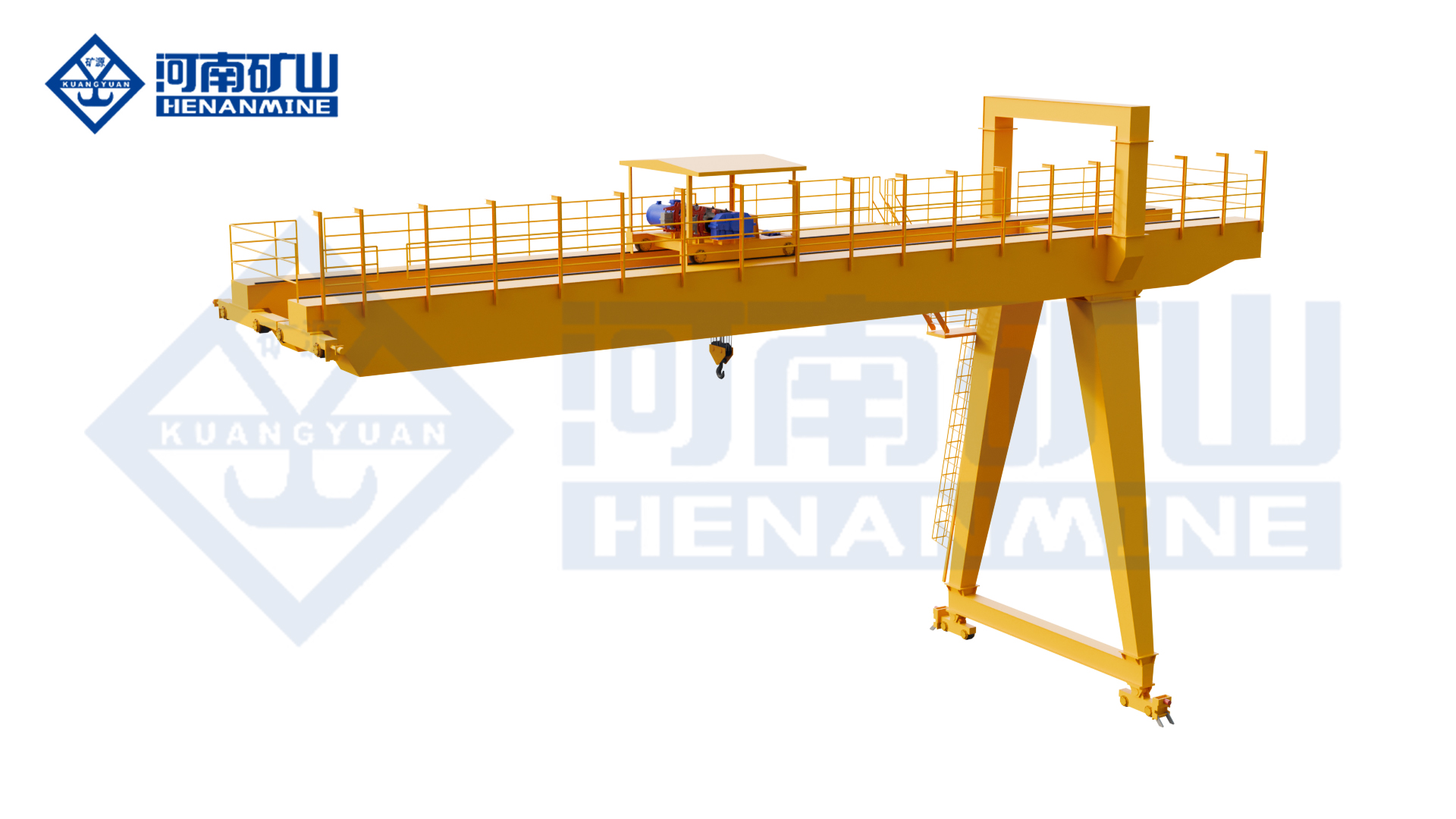
Choose a semi gantry crane when one side can run on a verified elevated support and the other on a ground rail. It can serve part of a workshop without spanning the whole building. Confirm both support reactions, rail alignment, floor access and the required hook coverage before comparing capacity or price.
01When a semi gantry is the right arrangement
| Site condition | Semi gantry decision |
|---|---|
| Workshop-edge machining or assembly area | Good candidate when partial-bay coverage is sufficient |
| Existing elevated runway or building support | Use only after its reactions and connections are verified |
| Forklift or pedestrian route beside the work | Check whether the ground rail and travelling leg can be segregated |
| No suitable elevated support | Compare a full gantry or separately supported arrangement |
| Another crane operates above | Coordinate operating envelopes, clearances and collision protection |
The arrangement saves a second full-height leg, but it does not remove the need for a structural load path. An existing wall, roof beam or runway should not be assumed adequate because it is already in the right position.
02Specify usable coverage and the two rail interfaces
Define the hook travel between its practical end positions. Nominal span is not the same as usable coverage: the hoist body, leg and end approaches reduce the area the hook can reach. Check required lift with the real load, rigging and available building height.
The elevated side and floor side must maintain the required rail geometry along the entire route. Differential settlement, misalignment or an unsuitable rail connection can cause wheel wear and poor travel. The crane supplier and civil or structural designer need compatible reaction and tolerance information.
For an illustrative workstation, a hook may need to reach 0.8 m beyond a machine edge for tool changes. A crane that covers the machine footprint but cannot reach that set-down position will not complete the job. Use the actual hook path to select the arrangement.
03Keep the ground route workable
The travelling leg introduces a moving obstruction at floor level. Plan separation from forklifts, stored material and pedestrian routes. Rail recesses, crossings, bumpers, end stops, warning systems and obstacle protection depend on the site; a sensor alone does not resolve an unsuitable traffic layout.
Match duty, travel speeds and hoist control to the production cycle. For outdoor service, include the specified environmental loads and parking or securing arrangements. A standard indoor crane should not be assumed ready for an exposed yard.
Compare the KSMB electric hoist semi gantry crane with full gantry arrangements where the building support or ground route is unsuitable.
04Semi gantry crane price references
Public sources checked on 28 October 2026 show the following USD equipment references. They cover different supply boundaries and cannot be treated as quotations for the same crane.
| Published reference | USD per machine or listed unit | Important scope limit |
|---|---|---|
| Supplier guide: semi gantry family labelled 5–50T, 10–30 m span | $4,500–$60,000 | Guide labels the range an indicative FOB China reference; no itemized configuration |
| Online semi gantry equipment listing | $15,000 | Capacity, span, hoist configuration and installed scope are not fixed on the listing |
The guide’s USD $4,500–$60,000 range spans many capacities and layouts; its endpoints do not price a specific 5 t or 50 t machine. These are third-party references, not Henan Mine offers. Confirm the hoist, electrification, rails and installation in the actual proposal.
Building reinforcement and ground-rail foundations can offset a saving in crane steelwork. Compare the complete installed alternatives before assuming a semi gantry will cost less than a full gantry. Freight, duties, taxes and site commissioning also require an explicit scope.
05Buyer questions
Can a semi gantry use an existing overhead crane runway?
Possibly, after structural capacity, rail geometry, wheel loads and operating clearances are checked. Existing use by another crane does not establish adequacy for the new combined arrangement.
Is a semi gantry always cheaper than a full gantry?
No. The equipment may use less support steel, but building reinforcement, ground-rail construction and traffic changes can outweigh that difference. Compare complete installed scope.