






















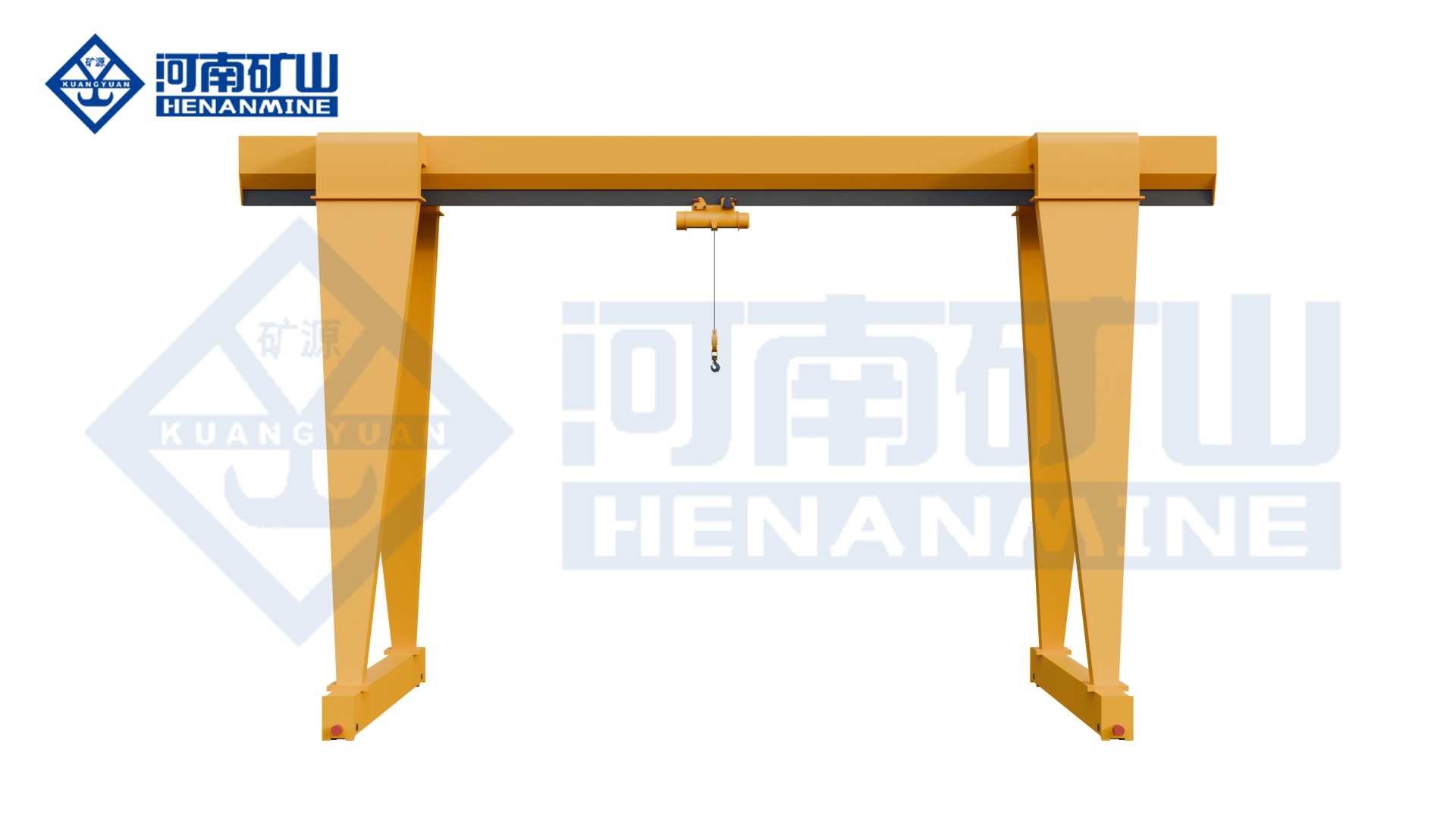
The hoist rating does not establish the capacity of the complete gantry. The approved system rating and load path govern; the frame must also accommodate the hoist, trolley and their imposed loads.
01Match the gantry, trolley and hoist
| Interface | What to verify | Common purchasing error |
|---|---|---|
| Frame and beam | Rated working configuration, span, height and permitted loading | Assuming every height/span setting has the same rating |
| Trolley and beam | Flange width/thickness, profile, adjustment, end stops and clearance | Selecting a trolley by lifting capacity alone |
| Hoist and trolley | Suspension interface, rated load, controls and complete headroom | Assuming a trolley-mount hoist includes the trolley |
| Gantry and floor/rails | Wheel loads, floor capacity, route and authorized travel | Assuming a wheeled gantry can move while loaded |
Manual push, geared and electric trolleys suit different travel distances and operating patterns. Powered travel changes the system requirements, including controls, cable management and acceleration behavior; it is not simply an accessory added to any frame.
02Calculate usable hook height before buying
Use the manufacturer’s assembled dimension drawing. Overall gantry height includes the beam and supporting frame; it does not state the highest hook position. Rigging and load depth use more of the available envelope.
Illustrative calculation: a beam datum is 4.0 m above the floor and the trolley/hoist assembly places the highest hook 0.65 m below it. Maximum hook height is 3.35 m. With 0.75 m from hook to load top, the highest load top is 2.60 m. This is below a 2.80 m clearance requirement, so that layout fails despite adequate lifting capacity.
Use actual equipment dimensions and allow the clearances required by the lifting plan. More chain or rope increases downward travel; it does not raise the upper hook position. The electric hoist selection guide covers the duty and lifting-speed checks.
03Gantry and hoist price references: separate scopes
| Public equipment reference | USD per unit | What remains to be confirmed |
|---|---|---|
| Portable gantry advertised 3 t/5 t family | $2,000–$3,000 | Quantity, exact capacity/span and hoist inclusion |
| Catalogued 1-US-ton electric chain hoist | $2,971–$3,239 | Lift/power variant, suspension and trolley inclusion |
Public listings checked 28 October 2026. The gantry listing uses quantity tiers: $3,000 for 1–4 units, $2,500 for 5–9 and $2,000 for 10 or more. Those tiers are not mapped to a fixed capacity and dimension. The chain hoist is rated at 2,000 lb, approximately 907 kg, with a 16 ft/min lifting-speed designation.
Do not add these unrelated listings into a package quotation. They are price references for different supply scopes; their compatibility has not been established. Neither range is a Henan Mine offer. Freight, tax, electrical integration, installation and acceptance requirements need separate confirmation.
04Portable gantry or powered production gantry?
For maintenance at changing locations, a portable frame may suit occasional lifts when its floor and movement conditions are met. Do not alter the beam, weld on attachments or change casters without the manufacturer’s engineering approval.
For a defined production route, compare an integrated MH electric hoist gantry crane. A double-girder hoist gantry crane uses a different supporting and trolley arrangement; select it for the actual span, duty and hook envelope rather than assuming two girders automatically make every application better.
Keep responsibility for the complete assembly clear. Before normal operation, the competent installation team must verify the approved configuration, brakes, limits, end stops, travel and applicable inspection/test requirements.
05Buyer questions
Can any electric hoist be fitted to a gantry crane?
No. Capacity, beam/trolley fit, suspension, headroom, duty and controls must be compatible. The frame manufacturer must permit the proposed configuration.
Can a portable gantry travel with a suspended load?
Only where the specific manufacturer permits loaded travel and the stated capacity, floor and movement conditions are met. Wheels alone do not establish that permission.