
Industrial Straddle Carrier Crane
Lift and transport beams, pipes or industrial modules across a multi-station yard.
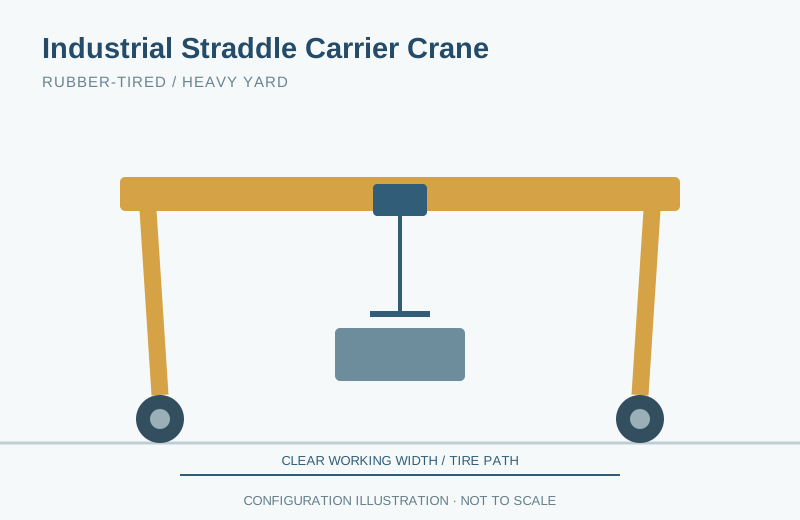
Where the Industrial Straddle Carrier Crane fits.
Select a straddle carrier when pickup and set-down stations cannot share a fixed crane runway.
Check load length and two-point support.
Define bundle restraint and overhang.
Plan trailer height and turning envelope.
Specifications for the Industrial Carrier selection.
The technical offer should state the rated load basis, complete lifting tool, operating envelope, duty and governing site reactions for your order.
| Parameter | Reference selection range | Procurement check |
|---|---|---|
| Product / arrangement | Industrial Straddle Carrier Crane | Confirm the exact machine and lifting device in the offered drawing. |
| Rated load for your order | Beam, pipe or heavy module | Include the attachment and rigging in the complete suspended mass. |
| Clear width / operating envelope | Set from the approved site and load drawing | Show the whole route, not only the pickup point. |
| Lifting height / under-clearance | Set from pickup, travel and placement | Include load depth, spreader or beam and safe clearance. |
| Duty / handling cycle | Select from lifts, loaded distance and shifts | State typical and maximum loads plus moves per hour. |
| Load family | Beams / pipes / modules | Rate the heaviest complete load and tool. |
| Clear width and height | Set by load envelope | Check gates, plant services and trailer interface. |
| Steering and braking | Set by loaded route | State turns, slopes and stopping distance. |
| Tire reactions / route | Calculated for the final selected machine | Check governing loaded, travel, braking and parked cases. |
Size the Industrial Straddle Carrier Crane for your site.
Send the heaviest load and its lifting points together with a dimensioned route. The quotation should state the selected machine, load-specific lifting beam, hooks or clamps, site reactions and acceptance method.
Load and toolProvide the beam, pipe or heavy module, attachment mass, lifting points and centre of gravity.
CoverageMark all pickup and set-down stations with loaded travel path on a drawing.
Operating cycleState loaded moves per hour, shifts, distances and required placement accuracy.
Site interfaceProvide bearing capacity, power, climate, access and destination requirements.
Check pavement, turns and transfer roads against final tire reactions.
Buy the complete Industrial Straddle Carrier Crane package.
Ask each bidder to quote the same lifting arrangement, site interface, tests and dispatch milestone.
Request the GA, rated configuration, all pickup and set-down stations with loaded travel path and governing reactions.
List the load-specific lifting beam, hooks or clamps, drives, braking, control and protection as included or excluded.
Set GA drawing, tire-load schedule, attachments and route acceptance, freight, site services and dispatch date in the contract.
Before you release a purchase order.
Use these questions to compare suppliers against the same technical and delivery scope.
Is rated load the same as payload?
No. The lifting beam, slings and any other suspended tool consume part of the hoisting rating.
What is the minimum order?
Ask for a quotation for one complete machine. Confirm the commercial minimum and exactly which attachments and services are included.
Which certificates and tests are included?
List the destination-specific compliance documents, factory acceptance test and site load or travel tests in the purchase specification.
How long will delivery take?
Request a dated factory dispatch commitment measured from deposit and approved drawings; show freight, erection and commissioning separately.
Send your Industrial Straddle Carrier Crane project brief.
Share your load and all pickup and set-down stations with loaded travel path, operating cycle, site conditions and destination. Ask for a matched GA drawing, reaction schedule, equipment list, tests and dated commercial offer.
Send your Industrial Carrier crane enquiry ↗- Load families, dimensions and maximum mass
- Approved lifting points and rigging
- Pickup/set-down elevations
- Route width, turns, grades and pavement
- Moves per hour and loaded distance
- Destination and test scope