| Customer application | Large aerospace equipment and solid rocket motor handling |
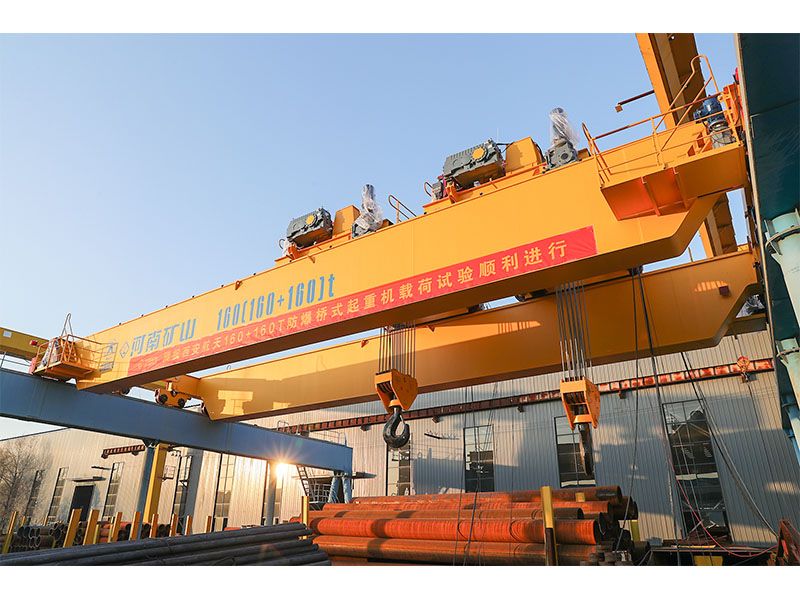
| Crane arrangement | 160 t + 160 t explosion-protected double-girder overhead crane |
| Test date | 4 December 2021 |
| Test programme | No-load, static-load, dynamic-load and rated-load tests |
| Milestone | Factory load tests completed |
Aerospace lifting combines load handling with hazardous-area requirements
The crane was manufactured for the Fourth Academy’s aerospace production work. Its stated lifting arrangement is 160 t + 160 t, and the equipment is an explosion-protected double-girder overhead crane. The two ratings describe the lifting arrangement; an actual lift must also follow the designed operating mode and approved load distribution.
For a purchasing team, the application joins two questions that need to be addressed together: how a large component is supported and moved, and how the crane is specified for the hazardous operating environment. Rated load alone does not answer the second question.
The factory test covered four operating conditions
Before testing, the project team prepared a detailed test programme, briefed the personnel on safety and checked the crane mechanisms. The programme then covered no-load, static-load, dynamic-load and rated-load tests, which the crane completed.
These stages examine different aspects of the equipment. No-load operation checks motion and mechanism behaviour; static loading examines the crane under load; dynamic and rated-load operation exercise the lifting and travel functions. A buyer comparing acceptance proposals should therefore review the test sequence and recorded results, not rely solely on a statement that a crane was “tested”.
Specify the hazardous area and the lifting procedure together
For an explosion-protected aerospace crane, the enquiry needs to describe the hazardous area classification, atmosphere and temperature conditions alongside the component mass, centre of gravity and lifting points. Those inputs affect equipment selection and the operating procedure.
If the lifting operation uses more than one lifting unit, discuss how load sharing, motion coordination and the permitted handling sequence are defined. The crane rating does not replace a review of the load geometry or the allowable operating modes.
Build an acceptance scope around your process
Ask for the crane configuration, applicable equipment documentation and project-specific test plan to be reviewed together. Explosion-protected equipment selection and successful load testing address different requirements; neither should be treated as a substitute for the other.
Send the component drawing, lifting-point arrangement, workshop envelope and hazardous-area requirements when requesting a proposal. Include the inspection and acceptance conditions for your destination so the technical scope can be reviewed before production.