
Ship-to-Shore Container Crane
Move ISO containers between vessel bays and terminal vehicles with a rail-mounted quay crane sized to your vessel fleet, berth and operating cycle.
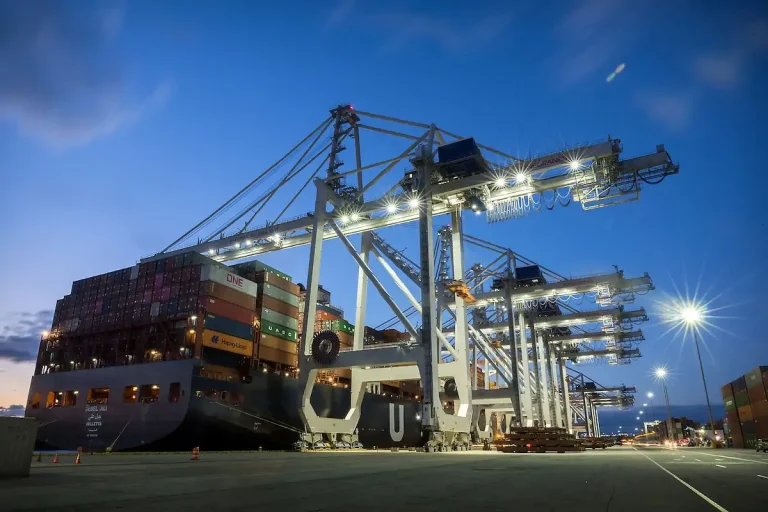
Start with the design vessel and the farthest box.
A dedicated STS crane is selected from the vessel-to-quay interface. Vessel beam and rows across set waterside reach; deck stacks, holds and water levels set the vertical envelope. Landside vehicle position and allowable quay loads complete the design basis.
State the current and future design vessels, container rows and farthest working position.
Check rail gauge, allowable wheel loads, fender offset, storm anchors and erection access.
Define transfer lane, spreader mode, positioning, TOS interface and manual fallback.
Specifications for the STS selection.
Use the available STS family ranges for initial screening. Each number refers to a family option, not a guaranteed combination. The approved offer must pair capacity, outreach, lift, speeds, duty and quay reactions for one crane.
| Parameter | Reference selection range | Procurement check |
|---|---|---|
| Rated lifting capacity | 40–65 t and 80–120 t published families | Confirm whether the rating is under spreader or hook, including spreader weight and twin-lift mode. |
| Waterside boom outreach | 40–72 m published family | Measure from the waterside rail to the farthest required container row. |
| Lift above rail | 25–45 m published family | Check top-tier container, spreader and operating clearance. |
| Lowering below rail | 15–30 m published family | Check lowest hold position over the full tidal and vessel-loading range. |
| Working class | A8 published family | Confirm the selected load spectrum and moves per hour. |
| Container formats | 20 / 40 / 45 ft by spreader selection | Define single, twin or other modes and the heaviest gross container. |
| Backreach / rail gauge | Project-specific | Show landside handover, portal clearance, rail spacing and maintenance access. |
| Wheel loads / storm restraint | Calculated for the final crane | Coordinate operating, parked, wind and seismic cases with the quay engineer. |
| Power / controls | Project-specific PLC and variable-frequency system | Specify available supply, anti-sway, TOS interface and fallback mode. |
Draw the vessel, fender and rails in one section.
Use one datum for the waterside rail, fender line, water level and vessel. That drawing establishes the actual outreach and lift; a vessel class label alone cannot size the crane.
Vessel envelopeProvide beam, rows across, deck-stack height, hold depth and future vessel allowance.
Berth geometryMark rail centres, fender offset, tidal range, vehicle lanes and portal clearance.
Load and cycleState container mix, gross mass, spreader mode and gross/net moves per hour.
Civil and powerSupply rail capacity, allowable reactions, storm anchors and electrical feed.
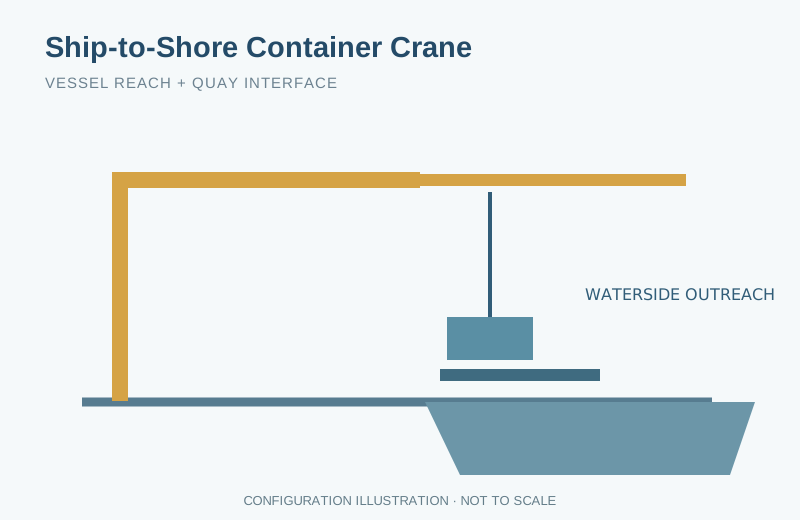
Confirm rail gauge, quay reactions and storm restraints on the approved berth drawing.
Purchase an integrated berth interface.
The commercial comparison should include the crane, spreader, civil interface, performance test and commissioning at the same terminal operating assumptions.
Require a GA drawing with reach, backreach, lift, rail gauge, wheel reactions and storm anchoring.
List hoists, trolley, boom, drives, spreader, controls, cable system and maintenance equipment.
Define FAT, lift and functional tests, site commissioning, operator training and agreed cycle test.
Before you release a purchase order.
Use these questions to compare suppliers against the same technical and delivery scope.
Is 120 t available at every 72 m outreach?
No. Published family limits are not one combined configuration. Ask for the rated-load chart and approved vessel/berth GA for your selected crane.
What determines waterside outreach?
The distance from the waterside rail to the farthest required container row, accounting for the fender line, vessel offset and operating clearance.
What is the minimum order?
Request a quotation for one complete STS crane or a coordinated berth package; confirm the commercial minimum and included spreader and services.
How are certification and delivery confirmed?
Agree the destination documents, factory and berth tests, and a dated dispatch milestone after deposit and drawing approval. Show sea freight, erection and commissioning separately.
Send your vessel and berth drawings.
Share vessel rows and beam, waterside rail-to-fender dimension, desired outreach and lift, container mix, target moves per hour, quay reactions, power and destination. We can then quote one coherent STS configuration with drawings, tests and dispatch scope.
Send your STS crane enquiry ↗- Design vessel, rows and beam
- Rail-to-fender and tidal data
- Reach and lift envelope
- Container gross mass and spreader modes
- Moves per hour and shift pattern
- Quay loads, power and destination