






















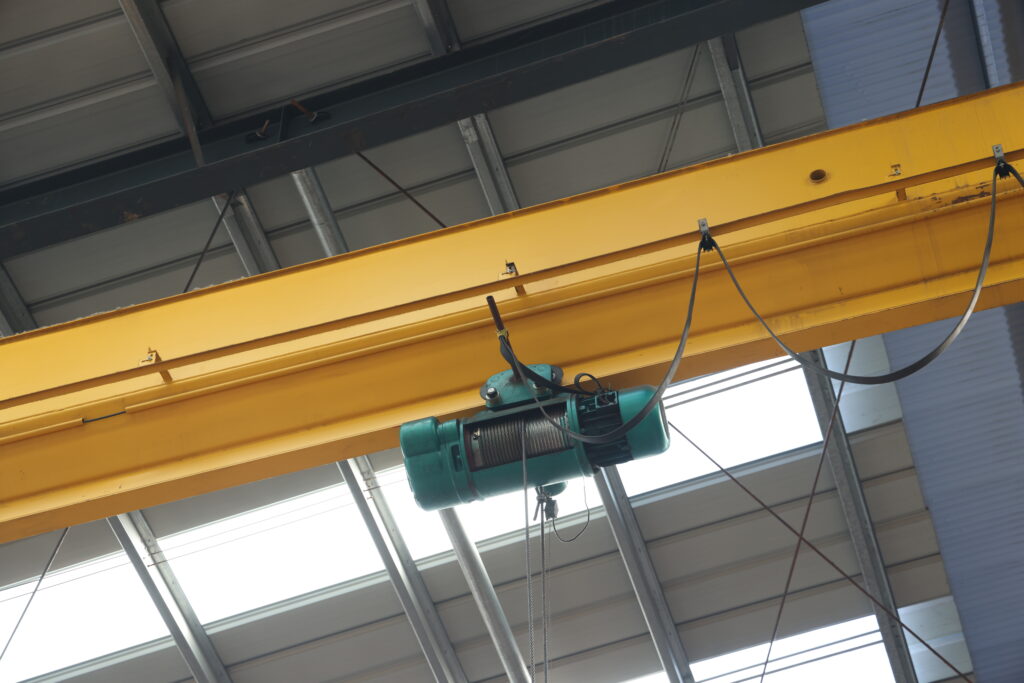
Remove the crane from service for suspected cracks, unreliable braking or rope damage that meets the applicable discard criteria. A competent inspection must establish whether the fault is local or part of a wider mechanism problem.
01Match the symptom to the inspection
| Observed symptom | Possible causes | Inspect before ordering |
|---|---|---|
| New gearbox noise or heat | Bearing or gear damage, lubrication problem, misalignment or excessive duty | Oil and debris, backlash, bearings, mounting and driven load |
| Oil leak at the shaft | Seal wear, breather blockage, shaft damage or bearing movement | Oil level, vent, shaft surface and bearing condition |
| Rope piling or uneven drum winding | Rope-guide fault, incorrect reeving, fleet angle or damaged grooves | Guide, anchorage, rope path and drum groove condition |
| Rope rubbing or sheave not turning | Bearing seizure, misalignment or incorrect groove profile | Sheave rotation, groove, pin, bearings and adjacent rope |
These symptoms narrow the investigation; they do not identify a part number. For example, a damaged sheave may be the result of misalignment elsewhere. Replacing it without correcting the rope path can damage the new sheave and rope.
02When repair is practical—and when to replace
Gearbox: seal replacement can be economical when shafts, bearings and gears remain serviceable. Contaminated oil, damaged teeth or worn bearing seats need a rebuild assessment. A replacement reducer must match the ratio, torque, mounting, shafts and brake interface.
Drum: assess cracks, groove condition, shell thickness, anchorage and shaft interfaces against the approved design. Do not machine deeper grooves or weld a damaged drum as an improvised site repair. An engineered repair procedure must establish remaining strength and inspection requirements.
Sheave: a bearing repair may be sufficient when the wheel, groove, bore and pin remain acceptable. A cracked or badly worn sheave needs replacement. Verify groove geometry against the specified rope; fitting a different rope to suit a worn groove is not a repair.
The crane spares selection guide explains how to distinguish loose parts from complete assemblies.
03Replacement component prices and repair scope
| Replacement component | Public reference, USD per piece | What the range covers |
|---|---|---|
| Parallel-shaft hoist gearbox | $300–$2,000 | Multiple reducer sizes and ratios; matching shafts and mounting required |
| Drawing-built wire rope drum | $1,000–$5,000 | Multiple drum sizes; bearings, shaft and coupling scope must be agreed |
| Machined steel sheave | $100–$600 | Multiple sizes and groove profiles; pin and bearing scope varies |
The gearbox listing was checked on 28 October 2026; the drum and sheave ranges were recorded on 24 October 2026. These marketplace family ranges are not Henan Mine quotations or installed repair prices. Dimensions are not mapped to the endpoints. Freight, tax, removal, alignment and commissioning require separate pricing.
No universal installed repair tariff follows from these part prices. A service offer should separate diagnosis, replacement components, dismantling, lifting access, adjustment and required testing. Rebuilding several worn components can cost more than replacing the complete lifting unit.
04Prevent a repeat failure before restarting
Confirm lubrication, alignment, fasteners, rope reeving, guards, brakes and limits under the manufacturer’s procedure. Complete the applicable inspections and tests before normal service. A successful no-load movement alone does not prove that a repaired mechanism is ready for production.
Record the cause and the corrected condition. Repeated gearbox overheating calls for a duty and load review; repeated rope damage calls for a drum-to-sheave path review. Where multiple hoist mechanisms are obsolete or damaged, compare a compatible replacement wire rope hoist with the documented rebuild scope.
05Buyer questions
Can gearbox noise be fixed by adding oil?
Low oil can cause noise, but adding oil does not repair worn gears or bearings. Check the prescribed lubricant and level, contamination, bearings and alignment before deciding on the repair.
Should the rope be replaced with a damaged sheave?
Inspect the rope along the affected travel and apply its manufacturer’s discard criteria and applicable standard. Replacing the sheave does not make a damaged rope serviceable.