






















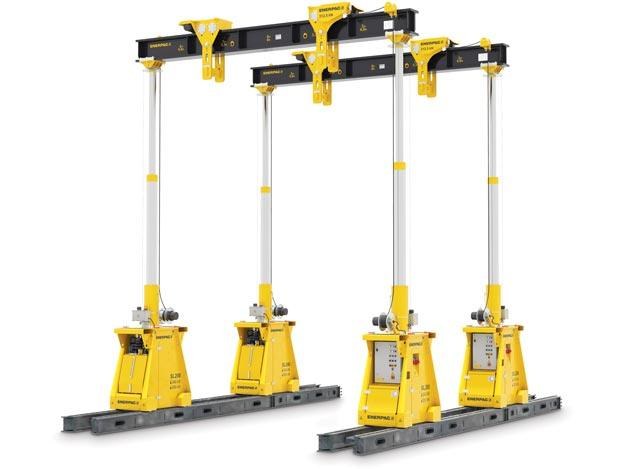
Hydraulic gantry cranes lift heavy equipment using synchronized hydraulic legs and header beams. Track travel and side-shift equipment can position the suspended load when included in the approved system. Capacity depends on the lift stage and arrangement. Public sold-out used listings reviewed in October 2026 showed USD 100,500–295,000 across different 220–500-ton systems.
01How does a hydraulic gantry lift a load?
Two or more lifting legs support header beams above the load. Lifting links and rigging connect the load to those beams. Hydraulic cylinders extend the legs, while the control system coordinates their movement. Ground-supported track carries the reactions where the arrangement uses rail travel.
This lifting method is often considered for presses, generators and other machinery installations where a conventional crane cannot reach the load. It still needs an engineered load path, suitable support and adequate setup space. See the hydraulic gantry operating sequence for the lift-and-position process.
02Hydraulic gantry types and motion options
| System characteristic | What it changes | Purchase implication |
|---|---|---|
| Compact hydraulic legs | Retracted size and access into restricted spaces | Check both access dimensions and rated lift envelope |
| Telescopic cylinder or boom legs | Extension stages and load capacity at height | Use the exact stage load chart |
| Track-travel arrangement | Movement along the lifting route | Confirm track, rollers, drive and loaded-travel approval |
| Side-shift arrangement | Crosswise positioning along the header beam | Confirm compatible lifting links, travel limits and rating |
These characteristics can be combined; they are not four mutually exclusive crane models. A system sold with lifting legs alone may need substantial additional equipment before it can complete a positioning job.
03Why headline capacity is not enough
Some designs retain capacity through their rated extension; others derate as the legs rise. A public four-leg product chart, for example, lists 220 imperial tons at the first stage and 150 imperial tons at the second. Those figures describe that specific model’s published chart, not every hydraulic gantry.
Check the unit convention and the complete load case. The center of gravity, beam span, lift points and suspended equipment affect reactions at each leg. An unevenly shared load cannot be assessed by dividing the total weight by the number of legs.
Floor or ground capacity is equally important. Tracks spread reactions over a defined support arrangement, but they do not make an unverified slab suitable for the lift.
04What does a hydraulic gantry crane cost?
New systems reviewed were quote-only. Public used-equipment records checked on 28 October 2026 provide the following historical asking-price references; all were marked sold out.
| Used listing and scope | Asking price, USD |
|---|---|
| 2001; 220 US tons; self-propelled; beams/track not itemized | 100,500 |
| 1997; advertised 400 tons; no lifting beams or track | 165,000 |
| 2004; advertised 500 tons; beams, links and runway listed | 295,000 |
The USD 100,500–295,000 span compares different machines and accessory sets, not a new-system price range. The latter two records do not state their ton convention. Equipment was offered used and as-is, with loading and shipping paid by the buyer. Site preparation, lift engineering, crew, mobilization and commissioning require separate budgets.
05When is another crane arrangement more practical?
Hydraulic gantries suit an installation method that needs controlled lifting and positioning within a constrained area. They are less suitable as a default choice for repetitive daily transfers along a production route, where an overhead or powered gantry arrangement may provide a simpler handling cycle.
Compare the full operating task before buying: occasional heavy placement, regular production lifting and mobile yard handling require different systems. The hydraulic gantry buying guide addresses equipment condition and missing accessories.
06Buyer questions
Is a hydraulic gantry the same as a portable hoist gantry?
No. Hydraulic legs raise the supported header beams. A portable hoist gantry normally lifts through a hoist suspended from its beam; capacity and operating methods differ.
Can a hydraulic gantry move a suspended load?
Only with the approved track-travel or side-shift arrangement, within its load chart and operating limits. Not every set of lifting legs includes those motions.