
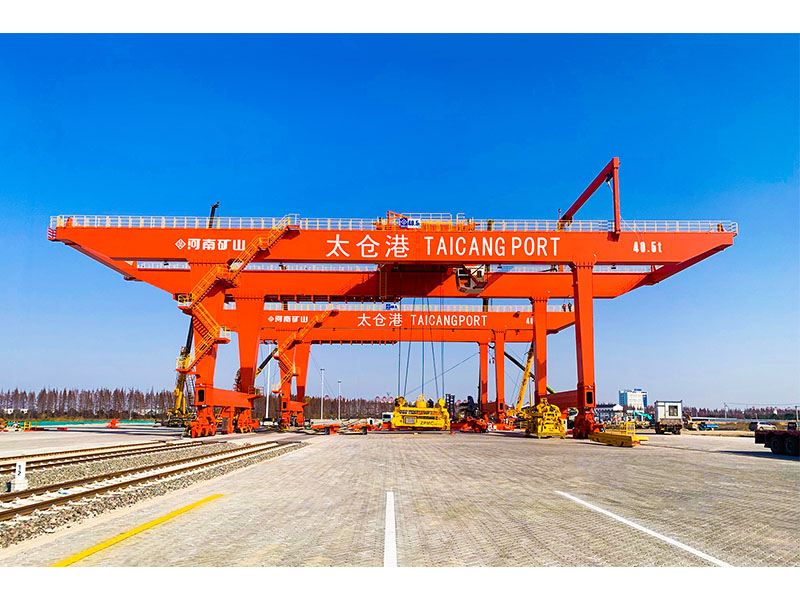
| Application | Container-yard handling at Taicang Port |
| Equipment | Two rail-mounted container gantry cranes |
| Control | Variable-frequency drives and Siemens PLC |
| Remote functions | RCMS monitoring and operation |
| Handling functions | Anti-sway, truck anti-lift protection and spreader positioning |
Two RMG cranes for the container yard
Taicang Port received two rail-mounted container gantry cranes tailored to its handling requirements. The delivery adds lifting equipment that travels on fixed rails across the working area, placing the rail geometry, stack layout and truck interfaces at the centre of the equipment specification.
The cranes were delivered within a demanding project schedule. The useful evidence for another terminal buyer is the delivered equipment and the stated control functions; yard throughput and lifting cycle targets still need to be established for the buyer’s own terminal layout.
Positioning controls address the container-handling task
Variable-frequency speed control and Siemens PLC systems coordinate crane motion. RCMS provides remote monitoring and operating functions. Anti-sway control helps manage suspended-load movement, while automatic container search, spreader guidance and spreader zero-position monitoring support the positioning sequence.
Truck anti-lift protection is a separate feature directed at the transfer interface between the container and vehicle. In a tender, the buyer should ask how that function detects and responds to an unintended lifting condition, rather than treating “intelligent control” as a complete description of the safety scope.
Match the trolley and spreader to the cargo
The cranes use a ring-trolley arrangement to accommodate different lifting positions. An interchangeable spreader arrangement extends the equipment’s handling options for the port’s cargo requirements.
For a comparable RMG order, the spreader specification needs to be reviewed with the container sizes, lifting interfaces and other cargo to be handled. Mechanical interchangeability, control connections and the operating procedure all affect whether a spreader change is practical in the yard.
Turn the terminal layout into a crane brief
Send the rail gauge, planned stack arrangement, truck lanes and required lifting height with your enquiry. Add the container sizes, lifting attachment requirements, power supply and control-room arrangement. A layout tied to these operating tasks supports a more useful comparison of RMG proposals than rated capacity alone.
If remote operation or additional automation is required, define the functions and acceptance demonstrations individually. Container positioning, anti-sway response and truck-interface protection should be assessed against the intended yard operation.