
Equipment maintenance
Remove and replace heavy components during planned shutdowns, with the hook positioned above the equipment and maintenance area.
Bridge cranes for workshops and production lines.
Explore Overhead Cranes
Ground-supported lifting for yards and construction.
Explore Gantry Cranes
Wire rope and chain hoists for lifting points and cranes.
Explore Electric Hoists

Wire rope lifting and pulling with a powered drum.
Explore Electric Winches
Grab buckets, magnets and hooks for your load.
Explore Lifting Attachments & Grabs
Mobile handling for containers, precast and yard loads.
Explore Rubber-Tired Gantry Cranes & Straddle Carriers

Lift and move vessels through boatyards and marinas.
Explore Marine Travel Lifts
Ladle, slab, scrap and coil handling across steel production.

Container stacking and cargo transfers across terminals and rail.

Turbine installation, powerhouse maintenance and wind equipment assembly.

Controlled component transfer and positioning for precision assembly.

Heavy fabrication, production lifting and factory crane automation.

Process lifting for smelters, carbon blocks and anode materials.

Clean lifting and classified protection for sensitive process areas.

Bridge fabrication, metro construction and ship block assembly.

Automated storage and retrieval for plates, cables and bins.

Follow project dispatches, crane engineering and factory acceptance.

Dispatch, installation and equipment in service

Crane configurations and handling technology

Factory inspections, acceptance and test programmes

Company developments, people and community programmes
Lift and move occasional heavy loads in workshops, stores and maintenance bays without an electric crane supply. The SQ uses a manual lifting mechanism and hand-driven trolley and bridge travel, with 5, 10, 16 and 20 t capacity selections.
Tell us what you need to lift and your approximate span. We’ll help you choose the lifting arrangement.
Start with the dimensions you already know. A workshop photo or sketch can help us recommend a configuration.
Manual lifting and travel serve a bay where powered crane movement is unavailable or unnecessary.
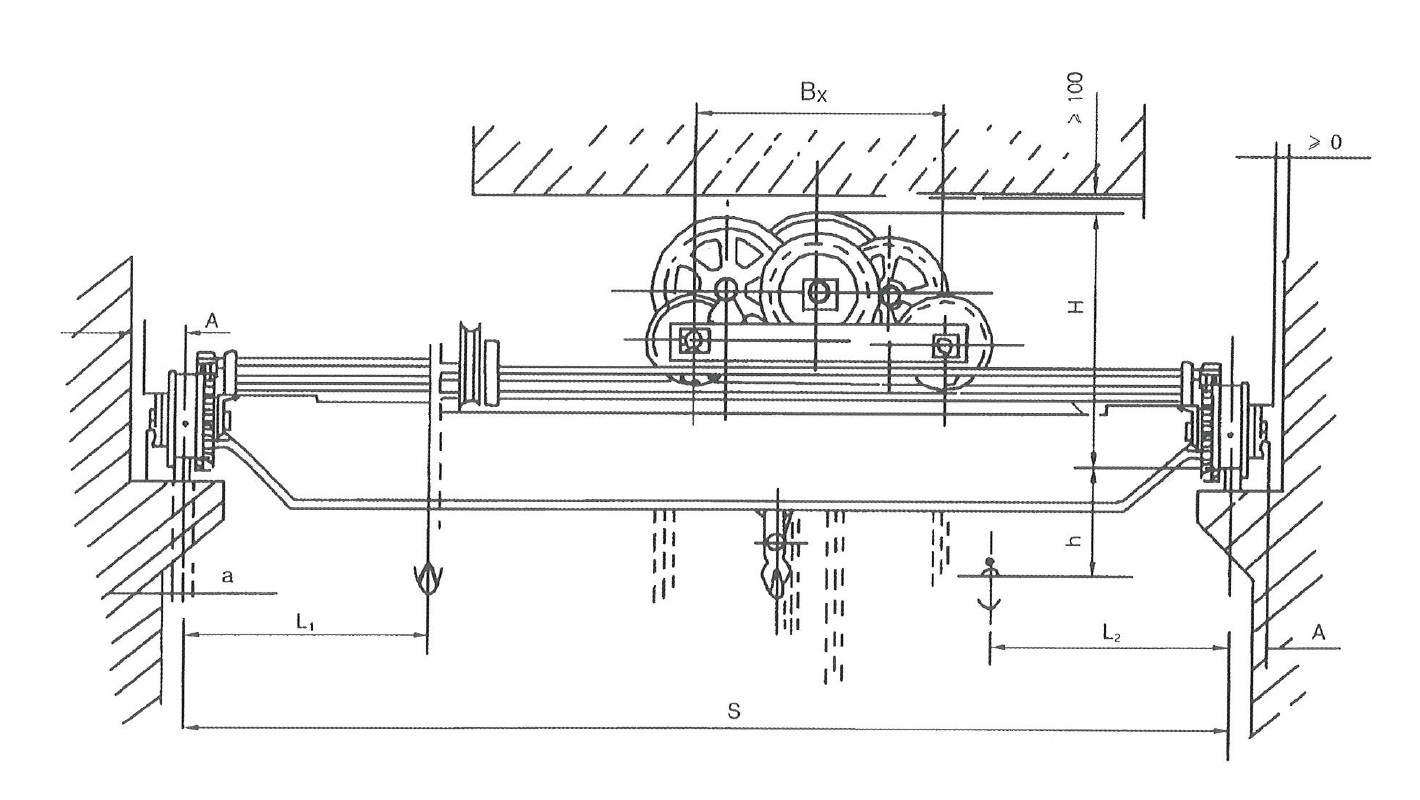
The trolley crosses the double girder bridge while the bridge moves along the runway, bringing the hook to the equipment pickup and set-down points.
Capacity selections up to 20 t allow an SQ crane to be considered for low-frequency equipment handling where travel speed is a secondary requirement.
Remove and replace heavy components during planned shutdowns, with the hook positioned above the equipment and maintenance area.
Move stored machinery and parts when there are few lifts per shift and the available time allows hand-operated movement.
Provide an overhead lifting arrangement for a defined working area where an electric crane power system is not part of the installation.
Choose SQ for occasional handling. For repeated production lifts or long travel distances, compare a powered LH or QD arrangement.
Compare the available options for your lifting task. Capacity, span, lift height and speed are matched in the selected configuration.
| Model | SQ |
|---|---|
| Rated capacity | 5 / 10 / 16 / 20 t |
| Span | 10–17 m |
| Lifting height | 10 / 16 m configurations |
| Working duty | Occasional manual handling; selected for lifting frequency and operating effort |
| Hoisting speed | Hand-operated lifting; speed depends on the selected mechanism and operator |
| Trolley / bridge travel | Hand-driven; travel distance and manual effort govern selection |
| Lifting arrangement | Manual lifting mechanism and hook trolley on a double-girder bridge |
| Control | Hand-chain operation for lifting, trolley and bridge travel |
| Power supply | Not required for basic manual operation |
| Operating environment | Warehouses, workshops and equipment-maintenance bays |
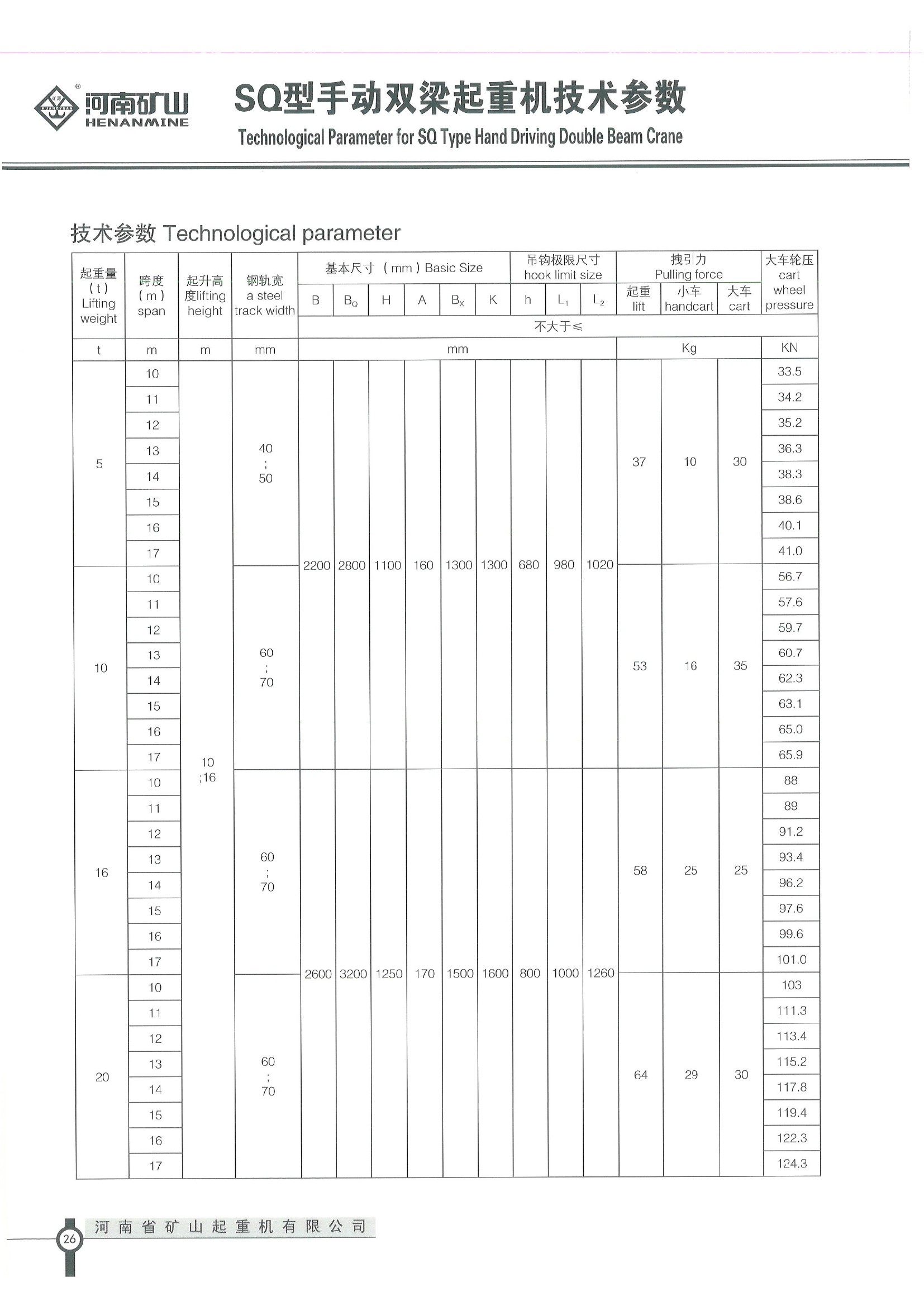
| 10 t selection example | 14 m span; lifting height 10 or 16 m; bridge wheel load 62.3 kN |
| Rail width, 10 t example | 60 / 70 mm according to the selected runway arrangement |
| Selected arrangement | Span | Lift options | Bridge wheel load | Rail width options |
|---|---|---|---|---|
| SQ 5 t | 14 m | 10 / 16 m | 38.3 kN | 40 / 50 mm |
| SQ 10 t | 14 m | 10 / 16 m | 62.3 kN | 60 / 70 mm |
| SQ 16 t | 14 m | 10 / 16 m | 96.2 kN | 60 / 70 mm |
| SQ 20 t | 14 m | 10 / 16 m | 117.8 kN | 60 / 70 mm |
These selections use a 14 m span. Other spans use their own mechanism, dimensions, operating effort and runway loads. Select the rail option with the ordered wheel arrangement.
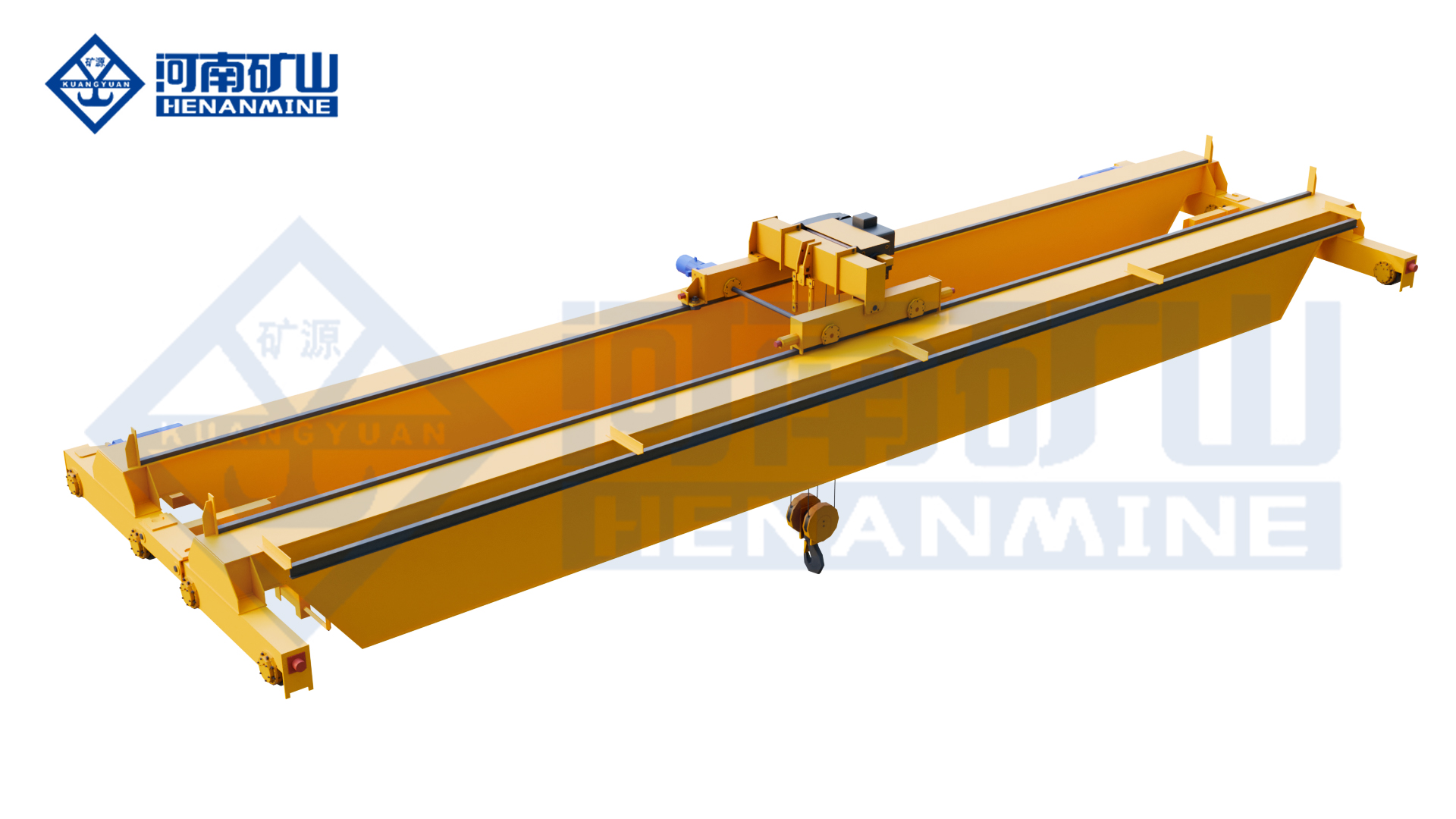
The equipment views show the double girder bridge, trolley and manual lifting mechanism.

The load, lift and hand-chain reach determine whether the manual arrangement suits the maintenance job.
Choose from the 5, 10, 16 and 20 t selections using the equipment weight together with the slings or lifting attachment.
Compare the 10–17 m span group and 10 or 16 m lifting-height selections with the pickup and landing positions in the bay.
Set the operating chain length for the working level. Consider the lifting distance, trolley travel and bridge travel for each job.
Match the selected crane wheels to the runway rails. The crane arrangement identifies its rail width, overall dimensions and wheel loads.
Compare the equipment, documentation, delivery and service scope for the configuration you need.
Request a single SQ crane or a project quantity. The offer confirms the minimum order for the selected manual mechanism and crane arrangement.
List the bridge, manual trolley, lifting mechanism, hand chains and hook equipment. Identify runway rails, site assembly, test loads and transport as included or separately priced items.
Specify the crane arrangement, installation dimensions, rated load, manual operating and maintenance instructions, and agreed inspection or load-test records. Identify any conformity documents required at the destination.
Confirm factory dispatch after capacity, span, lifting height, rail arrangement and operating chain lengths are approved. Shipping and installation are planned separately.
Agree unloading, assembly, runway installation and site testing responsibilities. Set hand-chain reach and operator access for the actual working level.
The order defines warranty coverage for the bridge, wheels, manual trolley, lifting mechanism and brakes. Confirm the recommended load-chain, hand-chain and brake wear spares.
Handle workshop and warehouse loads with an electric hoist on a double-girder bridge.
Compare this model ↗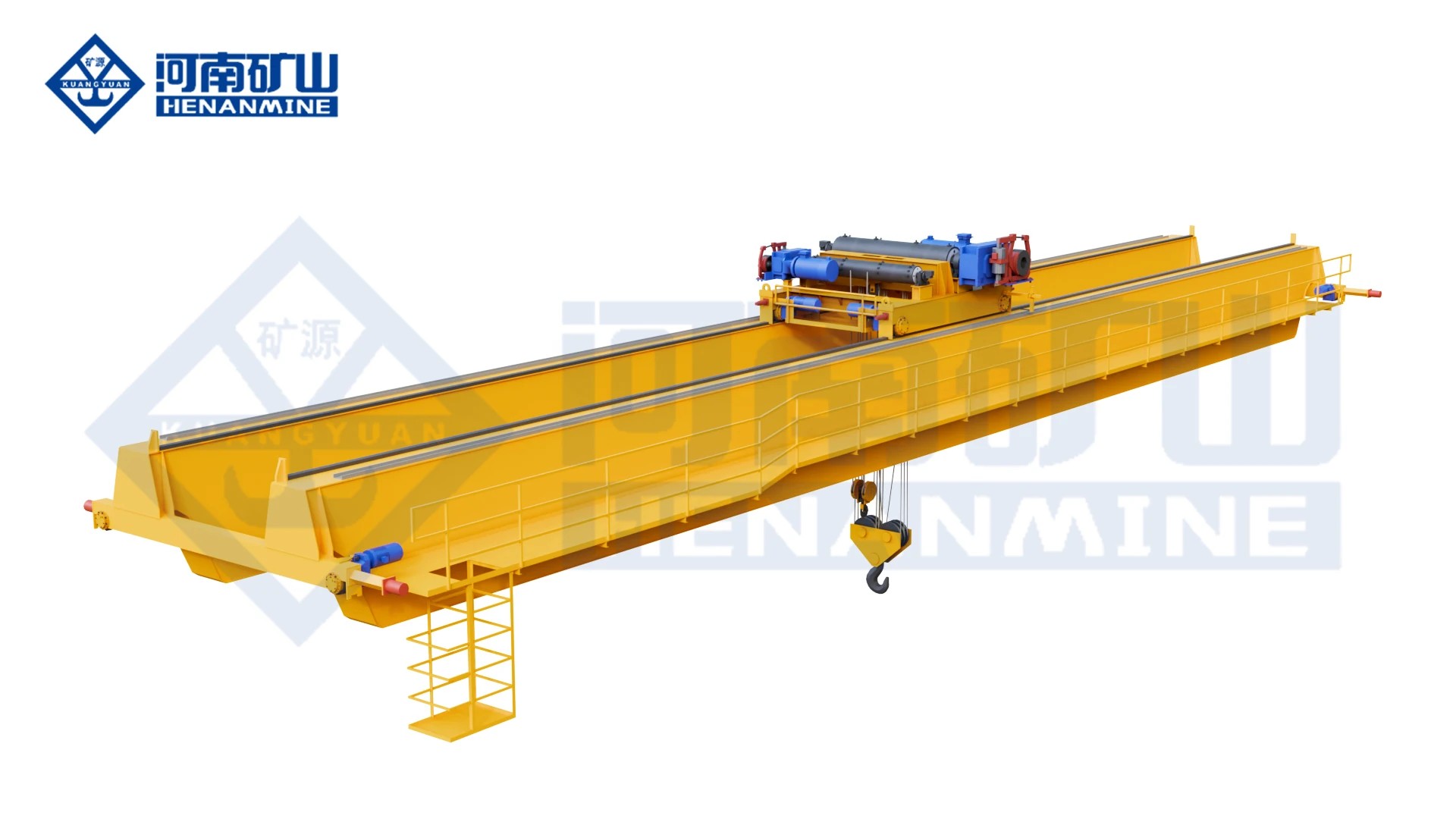
Lift machinery and workshop components with a conventional winch-trolley crane and a selected single or main/auxiliary hook arrangement.
Compare this model ↗Find the arrangement, equipment options and order information that suit your application.
The basic SQ uses manual lifting, trolley movement and bridge travel. It does not need an electric supply for those crane motions.
The selection group includes 5, 10, 16 and 20 t capacities, 10–17 m spans and 10 or 16 m lifting-height configurations. The selected mechanism and dimensions are identified with the crane order.
SQ is suited to occasional lifting where speed is secondary. If the crane will make repeated lifts throughout a shift, a powered crane can reduce manual effort and shorten the handling cycle.
Movement depends on the manual mechanism, load and operator input. SQ is selected by acceptable operating effort and time for the job rather than by a fixed motor-driven speed.
Hand chains operate the lifting mechanism and the selected trolley and bridge drives. Chain reach is arranged for the operator’s working level and the crane installation height.
It can be assessed against the existing rails and runway layout. Provide the rail size, rail-centre span and available crane space so the selected wheels and crane dimensions can be matched.
Send the maximum complete load, span, required lifting height and approximate number of lifts. Include the operating level and travel distances, plus the destination and requested supply or installation scope.
The offer confirms the dispatch schedule, manual-hoist and crane warranty coverage, installation responsibilities and support arrangement. The documentation package identifies safe operating instructions, inspections and recommended spare parts.
Tell us what you need to lift, your project location and any dimensions you already know. We’ll help you choose a suitable configuration.
info@cranehenanmine.com