Skip to content
Henan mine crane co., ltd. Get a project quote
QLC / MAGNETIC & STEEL HANDLING

QLC Lower Rotating Magnetic Beam Overhead Crane

Lift compatible steel along a magnetic beam and turn it beneath the trolley to match the landing direction. QLC combines a lower rotating electromagnetic carrier beam with photoelectric angle sensing, rotation-limit braking and selected anti-sway controls. Configure the beam, magnets and motion around the complete product range and the space available in your bay.

Lifting interface
Electromagnetic carrier beam
Rotation mechanism
Below the trolley
Angle control
Photoelectric sensing and limits
Capacity and dimensions
Configured for the project
Material-matched liftingDefined load & duty

Start with the information you already have. A load drawing and workshop sketch help us recommend a configuration.

01
Turn steel toward the next operation

Rotate the beam in the horizontal plane between pickup and landing. Define the required angle and full load sweep around stacks, columns and process equipment so orientation change fits the planned route.

02
Match magnetic support to the product

Select beam length and magnet spacing for plate, sections and compatible long stock. Net steel pickup follows both the crane's complete suspended-load limit and the magnets' capacity under the stated contact and temperature conditions.

03
Coordinate travel, rotation and approach

Photoelectric angle sensing and rotation-limit braking work with a bidirectional V-rope arrangement and selected electrical anti-sway functions. Specify the actual load, speeds and acceptance conditions for the placement task that matters to your process.

Installed double-girder crane with a lower-rotating magnetic beam above long steel stock
Lower-rotating magnetic beam above long steel stock.
01 / APPLICATIONS

Place magnetic steel in the direction the bay needs.

01

Plate storage and preparation

Move compatible plate between receiving, storage and preparation positions with different orientations. Define plate thickness, flatness, surface condition and any single-sheet requirement alongside magnet spacing and the permitted product overhang.

02

Section and long-stock transfer

Carry magnetic sections and long products between storage rows or production stations. Include the full length and weight range, pickup locations, beam-end clearance and load distribution so the same arrangement can be assessed across the agreed product mix.

03

Steel-mill and logistics handling

Combine magnetic pickup, overhead travel and a controlled orientation change within one bay. For coils or shaped products, provide the actual geometry and magnetic contact face so the attachment is selected for that specific pickup.

QLC is a dedicated electromagnetic-beam arrangement. State steel payload, rotating beam and magnet weight, available lifting height and permitted rotation in one project configuration.

02 / TECHNICAL SPECIFICATIONS

QLC specifications and configuration options

Compare the available options for your lifting task. Capacity, span, lift height and speed are matched in the selected configuration.

ModelQLC
Crane capacitySelected for steel plus rotating beam, magnets and other suspended equipment
Net steel payloadStated separately with the selected magnet and complete attachment weight
Span / runway lengthMatched to the working bay and material-transfer route
Lifting heightMatched to pickup, stack and landing levels with the selected attachment
Working dutySelected for load spectrum, lifts per hour and rotation frequency
Hoisting / travel speedMatched to the load, production cycle and positioning requirement
Lifting arrangementLower rotating electromagnetic carrier beam
Magnet layoutBeam length, magnet quantity and spacing matched to product size and magnetic pickup
Rotation rangeSelected for pickup and landing orientation
Rotation controlPhotoelectric angle sensing with rotation-limit braking
Mechanical anti-swayBidirectional V-rope arrangement
Electrical anti-swaySelected motion-control package; acceptance performance defined for the operating conditions
Magnet holding on power loss15–30 minute battery-holding package; required duration and test load in the order
Material temperatureMagnet, cable and protection package matched to actual pickup temperature
Power supplyThree-phase site supply and dedicated magnet power equipment selected with the package

The listed 15–30 min battery-holding time is a manufacturer reference. Confirm the supplied magnet, holding load and contact conditions, required duration, monitoring and acceptance test in the order. Backup magnet supply does not establish powered crane travel.

03 / EQUIPMENT VIEWS

Review the beam below the trolley.

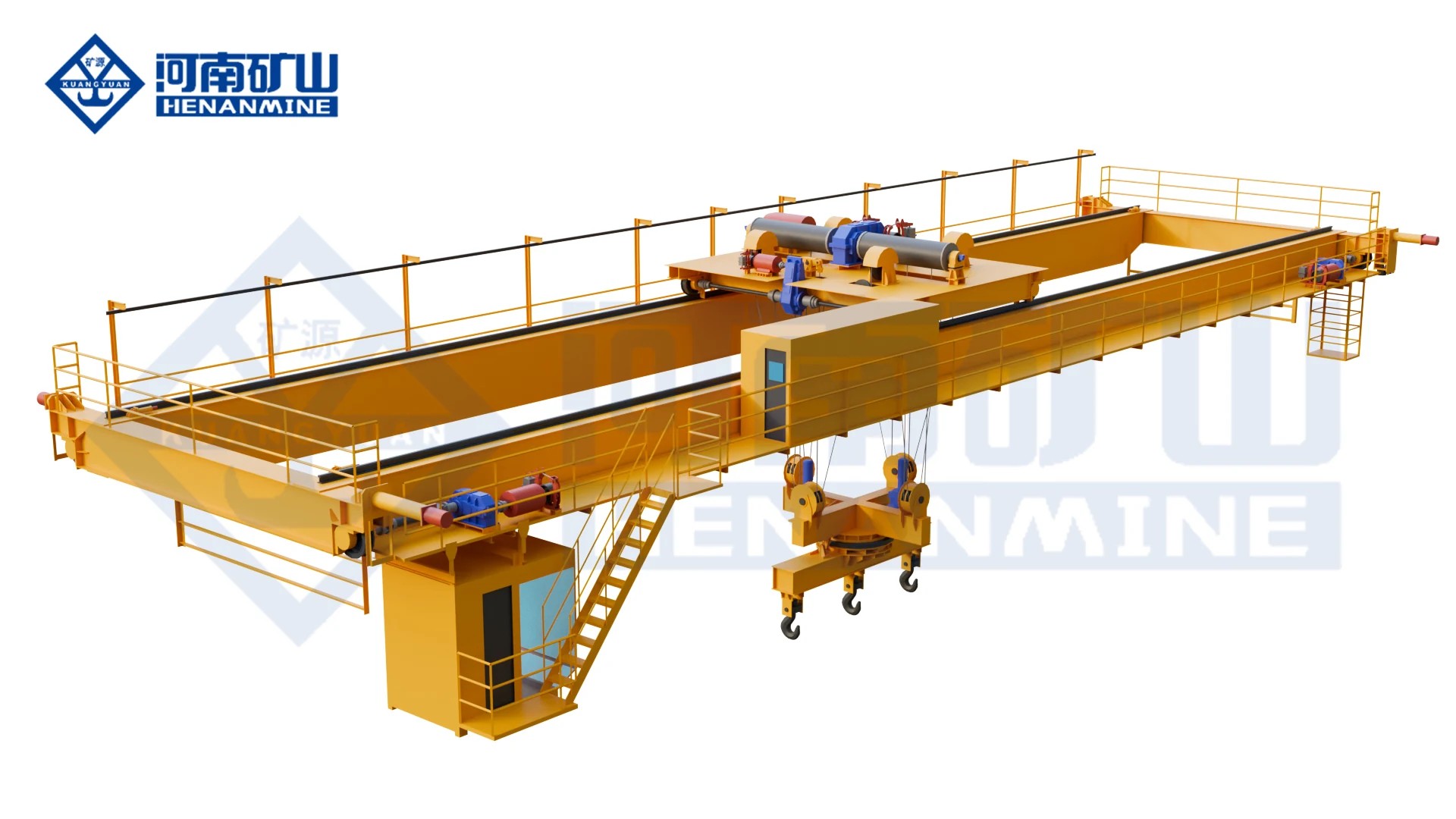
The equipment views show the lifting and rope arrangement with the lower rotating magnetic beam. Use the project drawing to check suspended depth, usable lifting height, beam-end clearance, cable movement and the angle limits at pickup and landing.

QLC double-girder overhead crane with a lower rotating magnetic carrier beam
QLC lower-rotating crane arrangement
QLC overhead crane end view showing the lower rotating magnetic beam and guide arrangement
QLC lower rotating beam
04 / CONFIGURATION

Configure QLC around your production task.

Start with the steel and its route, then select capacity, span, lift, duty and speeds. Lower-beam depth, magnetic contact and the full turning envelope belong in the same arrangement review as the crane and runway.

QLC double-girder overhead crane with a lower rotating magnetic carrier beam
QLC lower-rotating crane arrangement
01 / SELECTION

Product range and magnetic contact

Give grade, length, width or section, thickness, mass, surface condition and pickup temperature. Define single-piece or batch handling and the net steel target for each product group, including the least favourable agreed pickup condition.

02 / SELECTION

Carrier beam and magnet pattern

Select beam length, magnet number and spacing around product stiffness, support and stack access. Record all attachment weights and verify the required pickup and release behaviour, including single-sheet separation when it forms part of the order.

03 / SELECTION

Lower rotation and working clearance

Show pickup and landing angles, centre of gravity and the complete beam-and-steel sweep. Check the suspended depth against stacks and landing levels, then define permitted angles and motion restrictions for the actual route.

04 / SELECTION

Angle sensing and anti-sway controls

Configure photoelectric angle sensing, rotation-limit braking, bidirectional V-rope arrangement and the selected electrical motion controls. Agree positioning and residual-sway checks using the stated load, speeds, travel distances and measurement method.

05 / SELECTION

Excitation and backup holding

Specify magnet supply, cable equipment, release controls, required holding duration and alarms. Set the battery-holding test load and conditions, with crane-motion supply and any required recovery movement identified separately.

06 / SELECTION

Duty, environment and maintenance

Use shifts, lifts per hour, load spectrum and rotation frequency to select the duty and motion package. Identify material heat, workshop ambient conditions and dust, with access to rotation drives, ropes, sensors, cables and backup equipment.

05 / PURCHASING & HANDOVER

Define the equipment,
documents and delivery scope.

A useful QLC offer connects the steel range to a defined beam, magnet, rotation and control package. Compare the equipment and acceptance scope alongside the delivery programme and the services needed to put it into work.

Name every supplied system

List the crane, lower rotating beam, magnets, rigging, sensors, drives and controls. Identify excitation equipment, cable systems, backup holding and site power feed, with rails, runway work, freight and installation responsibilities stated separately.

Approve the technical schedule

Request crane and beam drawings, complete load, net steel payload, attachment weights, magnet data and contact conditions. Include suspended depth, rotation limits, wheel reactions, electrical drawings, operation and maintenance manuals and destination documents agreed for the order.

Define pickup and motion acceptance

Agree representative material, pickup and release conditions, angle-limit checks and any positioning or sway criteria. Include the selected backup-holding duration and test conditions, together with load tests and the allocation of factory and site checks.

Set approval and delivery milestones

Plan beam and magnet selection, arrangement approval, manufacture, factory functions and dispatch as separate steps. Confirm packing, shipping divisions, unloading access and storage, with the site programme aligned to the approved configuration.

Commission the selected route

Allocate assembly, rope and cable setup, electrical connection, material for pickup trials and local lifting support. Include rotation-limit setup, operator training and the agreed power-loss response in the handover responsibilities.

Support the beam and magnet package

Confirm warranty commencement, coverage, exclusions and service arrangements. Request inspection guidance and recommended spares for ropes, brakes, rotation drives, angle sensors, magnet cables, controls and the selected backup supply.

01Define pickup and landing

Send the steel range, contact conditions, net pickup target and the required change in direction.

02Check the lower-beam arrangement

Review suspended depth, full turning space, magnet pattern, load distribution and motion requirements.

03Approve the package and checks

Confirm equipment, backup holding, documents, acceptance conditions and delivery and commissioning scope.

04Verify the production movement

Check pickup, travel, rotation and release with representative material and hand over the maintenance plan.

DOCUMENTS TO AGREE

Technical schedule · General arrangement · Attachment interface · Runway loads · Electrical information · Safety-function description · Agreed inspection records · Operation and maintenance manuals

07 / PROCUREMENT QUESTIONS

Before you order
your QLC crane.

Review the lifting task, configuration and quotation scope. We can help develop a crane proposal from the project information available.

What makes QLC a lower-rotating magnetic crane?

Its rotating arrangement is below the trolley with the suspended electromagnetic carrier beam. The beam turns the steel in the horizontal plane to suit pickup and landing directions. The selected rotation range and full beam-and-load clearance are shown in the project arrangement.

How should I compare QLC, YC and QJ?

QLC uses a dedicated lower rotating magnetic beam. YC creates rotation through an upper trolley, while QJ is a lower rotating carrier-beam platform with a selected magnet or mechanical clamp. Compare the same product range, headroom, attachment depth, turning envelope and required pickup method.

Which capacity and speeds can I order?

Capacity, span, lifting height, duty and hoisting and travel speeds are selected for the project. Provide complete load, net steel target, handling distances, lifts per hour and the required placement task. The offer then states a matched configuration and its permitted operating conditions.

How much steel can the magnetic beam actually lift?

The crane's complete suspended load includes the steel, rotating beam, magnets and other suspended equipment. Usable steel payload also has to meet the selected magnets' pickup capacity under the stated material, geometry, temperature and contact conditions. Ask the quotation to give both the complete load and net steel pickup.

Can QLC turn the load through any angle or tilt it?

Specify the horizontal angle between pickup and landing and the clear working space. Photoelectric sensing and rotation-limit braking are configured for the ordered range. Tilting, inversion and repeated continuous rotation require a separately defined handling sequence, mechanism and service arrangement.

What anti-sway or positioning performance can I request?

QLC uses a bidirectional V-rope arrangement with selected electrical anti-sway controls. If a stopping accuracy or residual-sway value matters, state the load, travel and rotation sequence, speeds, measurement method and acceptance conditions. The technical offer can then identify the selected functions and the agreed performance check.

What happens to the magnet if mains power fails?

A selected battery-backed holding package has a 15–30 minute reference. Confirm the actual required duration, magnet load, contact conditions, battery condition, monitoring, alarms and test method in the order. Magnet holding does not establish powered crane travel or another recovery movement; those functions need their own defined supply and procedure.

Can QLC pick one plate or handle hot, coated or scaled steel?

Give the full plate or product range, grade, thickness, flatness, temperature and surface condition. Identify whether the task is single-piece separation or a defined batch. These inputs determine magnet selection, spacing and controls, and the representative material used to verify pickup and release.

Is this an electro-permanent-magnet system?

The QLC arrangement described here uses electrically excited lifting electromagnets. An electro-permanent proposal has a different attachment and switching principle, with its own controls, holding behaviour and acceptance scope. Identify that requirement explicitly if it is part of your procurement brief.

What should a complete QLC quotation include?

Request the crane, beam and magnets, excitation and cable equipment, rotation controls and selected backup holding, with complete and net load data and arrangement drawings. Compare agreed tests, documents, manufacture and dispatch milestones, freight, erection, commissioning, training, warranty terms and recommended spares as named scope items.


GET A CONFIGURED QUOTATION

Request your QLC
technical proposal.

Send the steel size range and the direction it must face at pickup and landing. We can configure a QLC proposal around the magnetic beam, lower rotation, working coverage and selected motion controls.

  • Crane and lifting device matched to the load
  • Clear configuration and supply boundaries
  • Drawing, testing and site-support scope

info@cranehenanmine.com

PRODUCT SELECTEDQLC Lower Rotating Magnetic Beam Overhead Crane

Include a bay sketch with stacks and obstructions, net steel target, pickup temperature and surface photographs. Span, lift, available headroom, cycle frequency, site supply and the required backup-holding and service scope help complete the brief.

↑
QLC Overhead CraneRequest your project quotation
Get a quotation ↗
QLC equipment gallery
Enlarged product image