
Stockpile-to-hopper transfer
Collect suitable loose material and discharge into a process hopper. Provide pile range, pit depth, hopper opening and material condition, including moisture and lumps that affect penetration, filling and release.
Bridge cranes for workshops and production lines.
Explore Overhead Cranes
Ground-supported lifting for yards and construction.
Explore Gantry Cranes
Wire rope and chain hoists for lifting points and cranes.
Explore Electric Hoists

Wire rope lifting and pulling with a powered drum.
Explore Electric Winches
Grab buckets, magnets and hooks for your load.
Explore Lifting Attachments & Grabs
Mobile handling for containers, precast and yard loads.
Explore Rubber-Tired Gantry Cranes & Straddle Carriers

Lift and move vessels through boatyards and marinas.
Explore Marine Travel Lifts
Ladle, slab, scrap and coil handling across steel production.

Container stacking and cargo transfers across terminals and rail.

Turbine installation, powerhouse maintenance and wind equipment assembly.

Controlled component transfer and positioning for precision assembly.

Heavy fabrication, production lifting and factory crane automation.

Process lifting for smelters, carbon blocks and anode materials.

Clean lifting and classified protection for sensitive process areas.

Bridge fabrication, metro construction and ship block assembly.

Automated storage and retrieval for plates, cables and bins.

Follow project dispatches, crane engineering and factory acceptance.

Dispatch, installation and equipment in service

Crane configurations and handling technology

Factory inspections, acceptance and test programmes

Company developments, people and community programmes
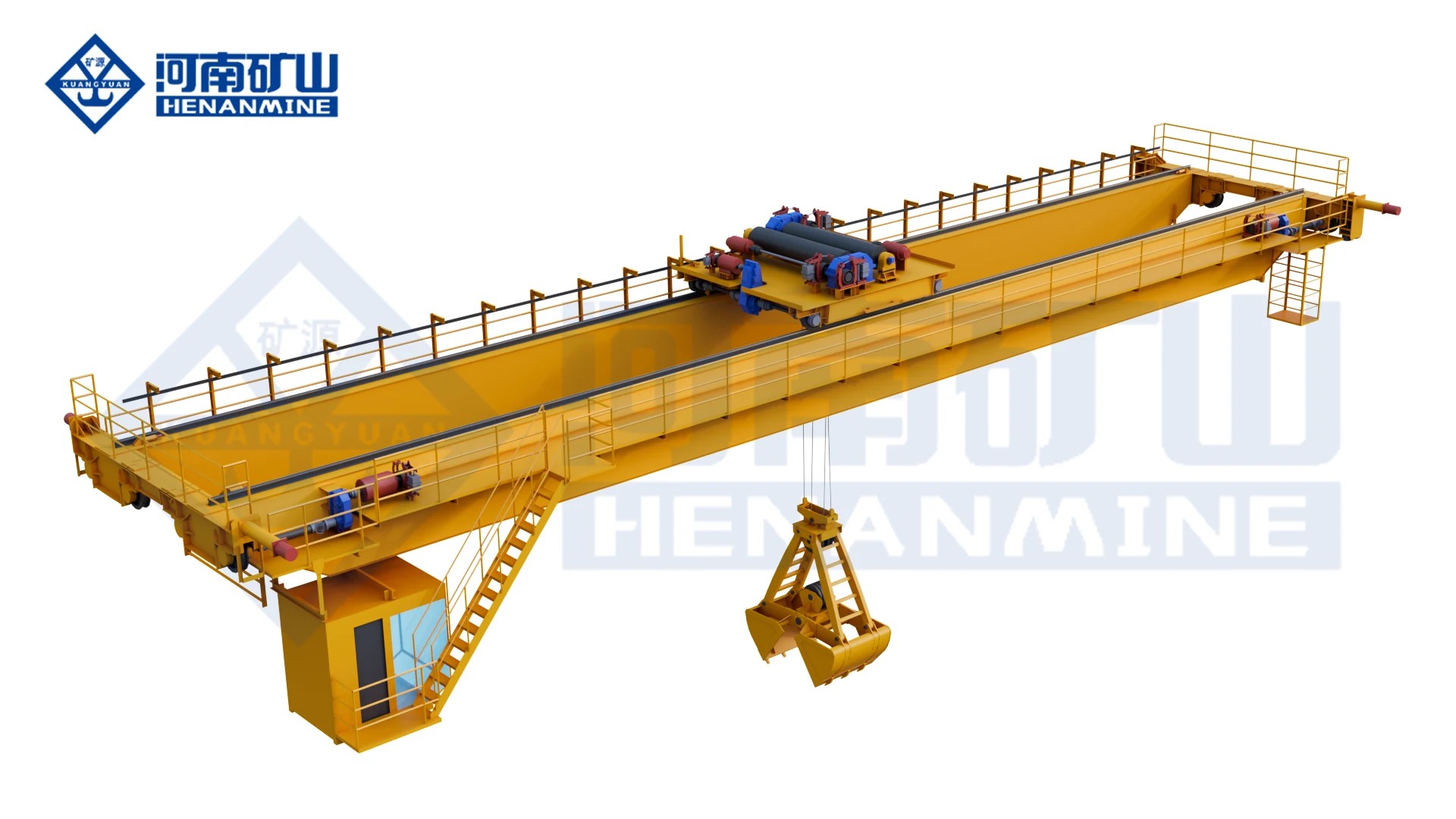
Move loose bulk material through a repeated pickup, travel and discharge cycle with a dedicated four-rope grab. QZ combines a double-girder bridge with separate holding and closing winches, with listed A6 selections from 5 to 20 t gross suspended load. Choose the grab for the material and receiving point, then assess useful output from the complete capacity-matched crane configuration.
Start with the material data and layout you have. A pile or pit photo, hopper drawing and operating cycle help us configure the crane and grab.
Separate holding and closing winches operate the four-rope grab through pickup and discharge. Select hoisting and travel with the actual route, filling time and receiving-point delays so the proposal addresses the plant's material flow.
Each listed rating has its own span, lift, hoisting speed, trolley speed and volume range. Keep these values together when comparing configurations so the offered crane can serve the complete route and load case.
Density-based volume references help narrow the grab selection. Confirm actual density, tare, particle size and filling behaviour to establish material payload and closing requirements for the selected bucket, rather than buying by volume alone.

Collect suitable loose material and discharge into a process hopper. Provide pile range, pit depth, hopper opening and material condition, including moisture and lumps that affect penetration, filling and release.
Move bulk material between defined receiving, storage and loading positions. Plot vehicle or container clearances, the grab opening direction and operator view through the complete travel route.
Supply bulk material to a production line over a stated daily cycle. Describe required tonnes per hour together with available handling time, transfer distance, loading peaks, waiting and operating shifts so the crane and grab can be assessed together.
QZ rated suspended load includes grab self-weight. Volume and density references support selection; actual material, useful fill and attachment mass determine payload. Automated handling and plant interfaces require an agreed configuration and operating specification.
Compare the available options for your lifting task. Capacity, span, lift height and speed are matched in the selected configuration.
| Model | QZ |
|---|---|
| Rated suspended load | 5 / 10 / 16 / 20 t, including grab self-weight |
| Span | 5 / 10 t: 10.5–31.5 m; 16 / 20 t: 16.5–31.5 m, in 3 m steps |
| Maximum lifting height | 5 / 10 / 16 / 20 t: 20 / 18 / 22 / 26 m |
| Crane duty | A6 for the listed standard selections |
| Hoisting speed | 5 / 10 / 16 / 20 t: 40.1 / 40.7 / 41.8 / 48.6 m/min |
| Trolley travel speed | 5 / 10 / 16 / 20 t: 44.6 / 45.6 / 43.2 / 43.2 m/min |
| Bridge travel example | 5 t, 10.5 m span: 93.7 m/min; other spans use their matched drive configuration |
| Lifting arrangement | Four-rope grab with separate holding and closing winches |
| Grab volume ranges | 5 t: 0.75–2.5; 10 t: 1.5–5; 16 t: 2.5–8; 20 t: 3–10 m³ |
| Grab opening direction | Parallel or perpendicular to the main girders, as selected |
| Control options | Cabin / pendant / radio / remote; automated package by specification |
| Automation options | Positioning, anti-sway and specified production or storage-system interfaces |
| Standard power supply | 380 V / 50 Hz / three-phase; destination supply by order |
| Material selection | Bulk density, lump size, moisture, fill behaviour, temperature and abrasiveness |
| Supply scope | Crane, matched grab, controls and agreed material-handling functions |
| Gross capacity | Span options | Maximum lift | Duty | Hoisting speed | Trolley speed | Grab volume options |
|---|---|---|---|---|---|---|
| 5 t | 10.5–31.5 m | 20 m | A6 | 40.1 m/min | 44.6 m/min | 0.75–2.5 m³ |
| 10 t | 10.5–31.5 m | 18 m | A6 | 40.7 m/min | 45.6 m/min | 1.5–5 m³ |
| 16 t | 16.5–31.5 m | 22 m | A6 | 41.8 m/min | 43.2 m/min | 2.5–8 m³ |
| 20 t | 16.5–31.5 m | 26 m | A6 | 48.6 m/min | 43.2 m/min | 3–10 m³ |
Gross capacity includes the grab. Span steps are 3 m within each row's range. Grab volume is selected separately for bulk density and attachment mass; bridge speed is confirmed for the selected span.
| Crane gross rating | Grab type | Grab volume | Material bulk-density band |
|---|---|---|---|
| 5 t | Light | 2.5 m³ | ≤1 t/m³ |
| 5 t | Medium | 1.5 m³ | >1–1.7 t/m³ |
| 5 t | Heavy | 1 m³ | >1.7–2.5 t/m³ |
| 5 t | Super heavy | 0.75 m³ | >2.5–3.3 t/m³ |
| 10 t | Light | 5 m³ | ≤1 t/m³ |
| 10 t | Medium | 3 m³ | >1–1.7 t/m³ |
| 10 t | Heavy | 2 m³ | >1.8–2.5 t/m³ |
| 10 t | Super heavy | 1.5 m³ | >2.5–3.3 t/m³ |
| 16 t | Light | 8 m³ | ≤1 t/m³ |
| 16 t | Medium | 4.8 m³ | >1–1.7 t/m³ |
| 16 t | Heavy | 3.2 m³ | >1.7–2.5 t/m³ |
| 16 t | Super heavy | 2.5 m³ | >2.5–3.3 t/m³ |
| 20 t | Light | 10 m³ | ≤1 t/m³ |
| 20 t | Medium | 6 m³ | Matched to actual material density |
| 20 t | Heavy | 4 m³ | Matched to actual material density |
| 20 t | Super heavy | 3 m³ | Matched to actual material density |
Confirm the actual bulk density, grab tare and fill behaviour before selecting a bucket. Net material payload is limited by both bucket fill and the crane capacity remaining after all suspended attachment weight.
The equipment views show the double-girder bridge, trolley and grab-handling arrangement. An installed example illustrates particular equipment rather than the rating of a new order. Use the approved drawing to check holding and closing rope paths, grab opening direction and envelope, trolley access and the route to the receiving point.


Select one matched capacity row, then size the grab around actual bulk density, tare and useful fill. Include pickup depth, discharge level, all motion distances and waiting time when assessing the cycle; separate maximum catalogue values do not establish a production rate.
State bulk-density range, largest lumps, particle distribution, moisture, temperature and abrasiveness. Give the net material target and filling conditions, then check material, grab tare, suspension and other gear against the selected gross rating.
Compare the 5, 10, 16 and 20 t selections using their paired span, lift, duty and speed data. State the actual runway and operating levels; a new combination outside a matched reference needs its own technical selection.
Select shell shape, volume and closing requirements from the material. Check whether opening parallel or perpendicular to the main girders better serves the hopper, container or pile, including the full open-bucket envelope.
Break the job into lowering, pickup and closing, lift, trolley and bridge movement, discharge, return and waiting. Give lifts per hour, shifts and maximum-load frequency so mechanism duty and useful output can be assessed for the stated route.
Choose the operating station from visibility and plant working arrangements. Describe any required positioning, anti-sway, weighing or process signals individually, with operating modes, interface responsibilities and checks included in the control scope.
Supply building clearances, rail-centre span, runway length and structural limits. Confirm destination voltage and frequency, dust, moisture, ambient heat and material temperature so the drives, cables, electrical package and grab are selected for the installation.
Treat QZ as a complete material-handling package: bridge, trolley, holding and closing winches, ropes, selected grab, controls and agreed power equipment. Compare offers on the same material payload and cycle, with drawings, tests, delivery and site responsibilities recorded alongside the equipment schedule.
List the bridge and trolley, both winch functions, rope and reeving scope, grab type, volume and tare, operating station and selected control functions. Identify rails, runway support, conductor equipment, hopper work and plant interfaces separately.
Use the same material density, useful payload, travel route, cycle and duty across quotations. Span, winch package, grab construction, wear requirements and automation scope change both price and suitability; maximum bucket volume alone is not a comparable output.
Agree the arrangement, maximum wheel reactions, capacity-paired motion schedule, bucket data and tare, rope layout, electrical information and manuals. Define crane and grab checks with representative material, discharge conditions, selected controls and agreed records.
Set drawing and grab-selection approval, manufacture, factory checks and dispatch milestones for the ordered package. Confirm packing, freight, delivery access, unloading and destination documents alongside the site's runway and power programme.
Allocate crane assembly, rope reeving, grab adjustment, power connection and control setup. Name who provides site lifting equipment, test loads and representative bulk material, then agree trial-cycle checks and operator training before handover.
Confirm warranty commencement, coverage, exclusions and service responsibilities. Request inspection instructions and recommended ropes, sheaves, brakes, grab edges and pins, drive and control spares, with part identification for the supplied configuration.
Send material properties, useful payload, required output, pickup and receiving geometry and operating shifts.
Review one capacity-matched schedule, bucket tare and volume, opening direction and the complete working cycle.
Agree drawings, control functions, representative material checks, delivery milestones and site responsibilities.
Commission grab pickup, travel and discharge with the agreed conditions, then hand over records, training and maintenance information.
Technical schedule · General arrangement · Attachment interface · Runway loads · Electrical information · Safety-function description · Agreed inspection records · Operation and maintenance manuals

Supply bins, hoppers and workshop storage points with a four-rope grab carried by a single-girder bridge. LDZ uses two electric hoists for the grab's lifting and closing functions and suits intermittent bulk-material work within the listed A3 selection. Start with the material and useful load per scoop, then check the filled grab, transfer route and required operating frequency as one handling task.
View this arrangement ↗
Develop a defined bulk-transfer route around a QZ four-rope grab crane, selected controls and the plant's operating signals. The intelligent configuration can include positioning, anti-sway and production or storage-system interfaces, with automated steps and operator involvement agreed for the site. Specify the material, working zones and exception recovery together with the selected crane, rather than treating a control label as a complete handling solution.
View this arrangement ↗
Handle loose bulk material and conventional hook loads in the same runway bay. QEN combines a project-selected grab arrangement with hook lifting for equipment, components or other approved loads. Define both jobs together so the lifting mechanisms, attachment positions, controls and operating duty suit the work. A detachable hydraulic-grab package can be specified with its power, connections and parking arrangement.
View this arrangement ↗Review the lifting task, configuration and quotation scope. We can help develop a crane proposal from the project information available.
Yes. The listed 5, 10, 16 and 20 t ratings are gross suspended loads including grab self-weight. Allow for the grab, suspension and any other carried gear when stating net bulk payload, then check actual density, fill and bucket operation for that material.
Materials of different bulk density need different volumes to produce a suitable loaded-grab mass. The reference table lists light through super-heavy grab selections. Confirm actual density, bucket tare, useful fill, lump size and closing requirements before fixing volume and net payload in the order.
Each capacity row is a matched reference, with its own span, maximum lift, duty, hoisting speed, trolley speed and grab-volume range. Use the row that fits the intended selection. Any different combination needs an expressly assessed crane and mechanism schedule.
Start with useful material per completed scoop and the number of completed cycles available. Include pickup and closing, lift, travel, discharge, return and waiting, with actual motion distances, pile levels and receiving restrictions. Agree throughput conditions and a test method if production output forms part of acceptance.
Separate holding and closing winches operate the grab's support and closing ropes. The crane and grab are selected as a coordinated system. The proposal should identify rope paths, closing requirements, permitted operating sequence and adjustment and maintenance instructions for the supplied equipment.
The grab can be configured to open parallel or perpendicular to the main girders. Choose the direction for the hopper, receiving position and nearby obstructions, then confirm the final geometry and open-grab clearances on the drawing. Field rotation is not included unless specified.
The ordered controls define the supplied operating arrangement. Positioning, anti-sway and production or storage-system interfaces are specified functions with their own signals, working zones and checks. Compare the Intelligent QZ configuration for a project-defined automated route and operator-recovery requirements.
Agree crane load and motion checks, holding and closing functions, rope operation, grab filling and discharge, limits and selected control functions. Identify test material, density and load conditions and any agreed cycle assessment, with records, site test resources, operator instruction and maintenance information included in the handover scope.
Send the material density and condition, useful tonnes per scoop or required process supply, and a sketch of the pickup-to-discharge route. We can use the span, levels and operating cycle to develop a matched QZ crane-and-grab proposal.
info@cranehenanmine.com