






















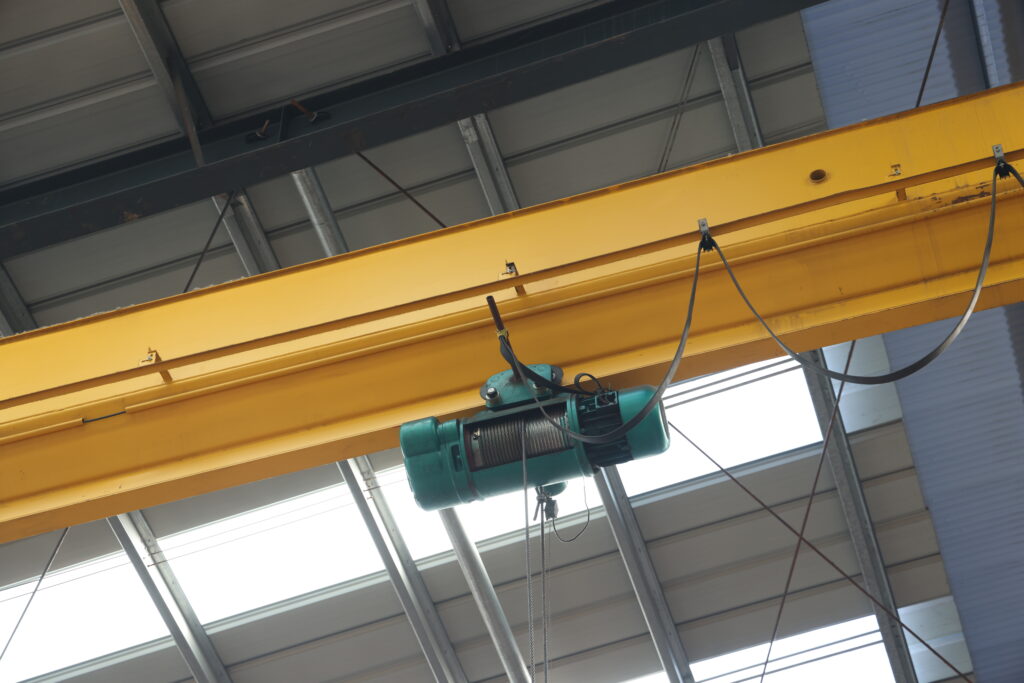
Chain and wire rope hoists can both serve overhead cranes. The right choice depends on the actual lifting cycle and mechanical fit; rated capacity and purchase price alone are insufficient.
01Electric chain hoist or wire rope hoist?
| Requirement | Chain hoist considerations | Wire rope hoist considerations |
|---|---|---|
| Local workstation handling | Compact lifting unit; check chain collection and mounting | Compare the complete hook envelope and available trolley designs |
| Long lift or production handling | Confirm duty, chain storage and speed for the actual cycle | Compare reeving, rope storage, speed and duty options |
| Restricted headroom | Compare assembled trolley-to-hook dimension | Consider a purpose-designed low-headroom trolley hoist |
| Precise positioning | Verify low speed or variable-speed control | Compare dual-speed or variable-speed configurations |
Avoid a fixed capacity cutoff between the two types. Both have light and demanding applications within their model ranges. Compare the proposed models against the same load spectrum, lifts per hour, starts and daily operating time.
02Specify the load and duty together
Count the payload plus the below-hook lifting device, slings and other suspended accessories. Use the maximum operating load and the applicable design requirements to select rated capacity. Do not apply an arbitrary percentage margin as a substitute for the required engineering assessment.
Duty depends on how often the hoist operates and how heavily it is loaded. Moving a near-rated load throughout a shift is different from occasional maintenance lifts. State the lifting distance, average cycle, starts, operating hours and load distribution. Different duty classification systems require a documented comparison.
For routine single-speed lifting, review the CD wire rope electric hoist. For controlled positioning or a different duty requirement, compare the relevant speed and drive configuration before ordering.
03Check the assembled hoist against the building
Verify beam flange width and thickness, wheel profile, trolley adjustment range, minimum curve radius where relevant, end stops and hook approaches. Trolley capacity does not prove beam compatibility. Double-girder layouts require the correct trolley arrangement rather than an underhung trolley selected by capacity alone.
Use the dimension drawing to calculate the highest usable hook position. A low-headroom wire rope hoist may recover useful height, but compare its complete envelope and side approaches.
Specify supply voltage, frequency, phase, control voltage and cable arrangement. Pendant or radio control must operate within the crane’s control architecture. Dust, rain, corrosive conditions or hazardous areas require the appropriate model and documented protection, not an assumed upgrade to a standard hoist.
04Electric hoist prices: compare the same supply scope
| Public listing reference | USD per hoist | Configuration boundary |
|---|---|---|
| CD/MD wire rope hoist family | $300–$5,000 | Multiple capacities and lifts; no fixed 5 t or 10 t price |
| Catalogued 1-US-ton chain hoist | $2,971–$3,239 | 16 ft/min model family, with lift and power variants |
Public prices checked 28 October 2026. These are equipment references, not Henan Mine quotations or a direct comparison of equivalent specifications. One US ton is 2,000 lb, approximately 907 kg; one metric tonne is 1,000 kg.
Confirm trolley inclusion, suspension, pendant, controls and lift for the selected variant. Freight, tax, crane integration, power supply and installation are separate unless expressly included. Compare a chain hoist with electric trolley as an assembly when powered beam travel is required.
05Check lift height with a simple layout example
Illustrative layout: the support datum is 6.0 m above the floor and the proposed assembled hoist needs 0.8 m from that datum to its highest hook position. The highest hook is therefore 5.2 m. If the load and lifting attachment require a 5.4 m hook position, this arrangement cannot perform the lift, even when its capacity is sufficient.
Use the supplier’s actual datum and dimension drawing for the final calculation. Increasing rope length cannot recover a shortfall at the upper hook position.
06Buyer questions
Is a remote-controlled hoist automatically better?
Radio control can improve operator positioning, while a pendant may suit a defined workstation. Select the control method for visibility, environment, crane integration and the operating procedure.
Can an existing beam take a larger hoist?
Only after checking the beam, supports, wheel loads, trolley fit and complete system rating. Installing a higher-capacity hoist does not increase the crane’s rated capacity.